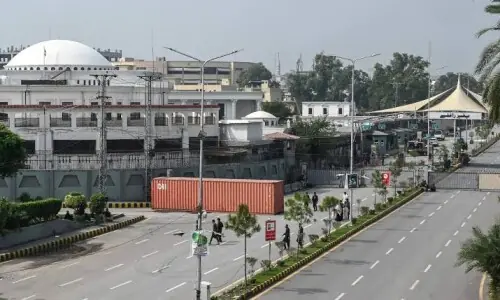
FOR four hours this week, all social media platforms in the country were shut down, a measure the government said was necessary ahead of the clampdown on violent TLP supporters on Friday. Successive governments have blocked mobile networks and platforms such as TikTok, Facebook and YouTube on separate occasions in the past, but this blanket freezing of all internet-based communication applications is unprecedented.
Without prior notice, the government prevented millions from using these platforms to “maintain public order and safety” — a step that bodes badly for future internet freedoms as the threat of more unannounced, arbitrary bans looms. The negative effects of such a ban have not been lost on the government.
After the clampdown, Interior Minister Sheikh Rashid apologised to Pakistani citizens for the inconvenience the government’s step had caused them, and said that the measure had become “essential” as violent protests were feared. However, his apology does not change the fact that the move was a naked display of the state’s ability to block social media and the internet at will. If anything, it has shown that in the future, a protest campaign or demonstration by one of the mainstream groups, can also trigger such a draconian step in the name of public safety. For large-scale public protests, where violence is always a possibility, such a ban has set a dark and dangerous precedent.
The state should employ more effective strategies to deal with such situations and handle the latter through strong law-enforcement mechanisms. Depriving citizens of their fundamental right to communication is contrary to democratic norms, and should only be considered when there is a serious threat of a terror attack. By framing its action as a necessary evil for public order, the state has unwittingly admitted its failures.
The interior minister’s promise that this would not happen again is simply not enough, especially given how rapidly freedoms are being eroded in the country. Attempts by the government to criminalise criticism, block access to platforms and grant the authorities sweeping powers of surveillance are a normalised reality. Digital rights activists have repeatedly criticised the social media rules framed under the Prevention of Electronic Crimes Act, 2016, through which the government can block and remove content it deems unlawful. With all these signs of the government’s desire to control the conversation on these platforms, this past week’s blanket ban is yet another reminder of the government flexing its censorship muscle.
Published in Dawn, April 18th, 2021