KARACHI: Veteran journalist and former chairman of Karachi University’s mass communication department Prof Syed Mateen-ur-Rehman Murtaza was laid to rest in the university’s graveyard on Tuesday.
He passed away on Monday night following complications from a surgery. He was in his 80s.
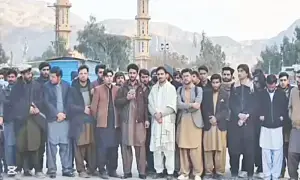
His funeral prayers were offered after Zohr at Masjid-i-Ibrahim, which were attended by a large number of university teachers, his relatives and friends.
He is survived by a widow and three daughters.
An excellent Urdu prose writer, Prof Murtaza was best known for his rational, bold and analytical editorial writings, particularly for daily Jasarat and later weekly Takbeer during Ziaul Haq’s regime.
Prof Murtaza had migrated from East Punjab to Pakistan. He recollected his childhood memories of migration — during which he along with his younger brother got separated from the family — in a booklet titled Me Ne Pakistan Bante Dekha. Its second edition is currently under publication.
His other book is Sir Syed Ka Nazaria-i-Sahafat Aur Doosre Mazameen.
He joined KU in 1972 and held the charge of chairperson of the mass communication department from 1988 to 1991. As a committed teacher and head of the department, he helped nurture numerous students into journalists that now serve various public and private media organisations.
One of his major contributions to journalism was Urdu translation of at least 15 English course books, currently part of the mass communication department’s syllabus at different universities. In 1970, he joined Jasarat from Multan and later started working from Karachi. During this period, he remained extensively engaged in editorial writings.
“His forceful independent views earned the ire of the Bhutto government which closed down the paper quite a few times and jailed Salahuddin Shaheed, the paper’s editor,” recalls Prof Tahir Masood, former chairman of KU’s mass communication department, adding that both Prof Murtaza and late Salahuddin were intellectually close to each other.
“This strong relationship came to the fore when Salahuddin Shaheed left his job when Prof Murtaza was sacked by the administration, arguing that as paper’s editor he was responsible for what’s published. They were one again under Takbeer, a widely read weekly in those days, launched on March 23, 1984.”
After retiring from KU in 1999, he laid the foundation of the mass communication department at the Jinnah University for Women and then at Jamia-tur-Rasheed. The other newspapers he wrote for included Mashriq, Hurriyat and Islam.
He also represented Pakistan at the United Nations and acted as Nawaz Sharif’s speech writer in his first tenure.
“Ethical and moral values were central to his life and he taught us to sacrifice everything for your conscience, beliefs and freedom of expression,” said Prof Masood.
Dr Fauzia Naz, the current chairperson of KU’s mass communication department, also Prof Murtaza’s student, said: “He was both a great human being and teacher. He helped explore my hidden potential for which I would always remain grateful.”
Published in Dawn, March 17th, 2021