Health experts 'shocked' as Indian authorities grant emergency approval to homegrown vaccine

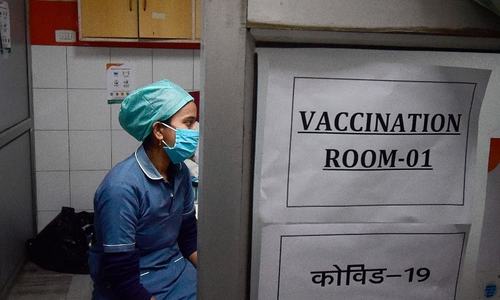
A homegrown coronavirus vaccine will be rolled out in India from Saturday even though clinical trials haven't been completed. But the government insists it will be safe and effective.
The All India Drug Action Network (AIDAN), an independent watchdog, led a chorus of concern from experts saying it was “shocked” and “baffled” by the emergency approval of Covaxin.
India has been hit hard by the virus, logging the second-highest number of Covid-19 infections globally with more than 10.5 million cases, and over 150,000 deaths — behind only the United States and Brazil.
In early January, New Delhi greenlighted Covishield, a version of AstraZeneca and Oxford University's shot made by India's Serum Institute, the world's largest vaccine manufacturer.
But it also gave “emergency approval” to Covaxin, developed in India by Bharat Biotech and the Indian Council of Medical Research, even though phase 3 human trials were yet to be completed.
Authorities stated — without releasing supporting data — that Covaxin might work better against new Covid-19 strains than other vaccines that use different technologies.
According to Prabir Chatterjee, a community medicine specialist in West Bengal, the lack of data was causing “a lot of upset among doctors and very senior doctors and scientists".
“I would guess that the Bharat Biotech vaccine, after it has been evaluated, may be the best, the cheapest and the most practical for developing countries,” he told AFP.
“But [...] I don't think we should jumpstart the process by using it before it has been proved.”
The main opposition Congress party accused the government of putting lives at risk. The health minister of one state, Chhattisgarh, has said the Bharat vaccine is “not safe” to deploy.
Critics suspect that the swift approval was motivated by Prime Minister Narendra Modi's protectionist push for “self-reliance”, and by the desire to save money.
The government responded to the criticism by saying the vaccine is “110 per cent safe”.
Husband and wife
Privately owned Bharat Biotech, set up in 1996 by husband and wife Krishna Ella and Suchitra Ella, is an established player in inoculations.
It has delivered over three billion vaccines for diseases worldwide including Zika and Japanese Encephalitis and an ultra-cheap shot for Hepatitis B.
The firm intends to supply Covaxin to other countries including Brazil.
But activists have accused the firm of cutting corners and breaching rules in conducting trials in India.
In the central city of Bhopal, Bharat's local partner — the People's College of Medical Sciences and Research Centre — paid 750 rupees ($8) each to 1,722 recruits.
Rajesh Kapur, vice chancellor of the private hospital, said it adhered to all proper protocols and ethical practices, including counselling and monitoring subjects, seeking their informed consent, and arranging care in case of health complications.
But 10 participants AFP spoke with, several of whom are illiterate, said they had not been properly informed.
Some said they were not given any documentation or briefing, while others said they were told they were being given a vaccine that would soon become mandatory nationwide.
Being informed of risks and signing consent forms have been mandatory since the government tightened the rules of drug testing — a booming industry in India — following a number of scandals.
Illiterate wage labourer Mannsingh Parihar, 70, said he and four others were driven to the hospital on December 21 and given the injection.
“They did not say a word [about it being a trial]. They gave the injection and money and asked me to go,” he told AFP.
Similar allegations are echoed by other participants interviewed by Indian media and by activists.
“No informed consent was taken, no adverse events have been recorded, no monitoring and follow-up is being done,” activist Rachna Dhingra said.
Public concern was fuelled by the widely reported death of one trial participant, nine days after being injected.
A post-mortem said the cause of death was suspected poisoning and Bharat said the death appeared to be “unrelated” to the trial dosing.
A detailed email questionnaire from AFP to Bharat on the claims was not answered.
The Bhopal controversies have been a lightning rod for criticism across the nation about the trials and the wisdom of rushing the vaccine's roll-out.
“There seems to be clear misses in the way these trials have been conducted,” said Anant Bhan, an expert on bioethics and health policy.