 AFTER three hundred years, Asia is rising again. Much of the continent is now generating wealth and power not by any abundance of natural resources but by the creativity of its human capital and the productivity of its enterprises.
Asia has now learnt the secrets of the revolution that truly keeps unfolding over time and influencing the lives and wellbeing of the people as well as nations across the globe- the one and only, industrial revolution.
Any society that has not come to terms with industrial revolution has not risen from its poverty and powerlessness. And every society that has understood it and mastered its working has continued to grow in wealth and power from its myriad applications and there are no limits to what can be achieved- whether on moon, mars or on this earth.
Europe, of course, ushered in the industrial revolution and reaped immense benefits. Powered by industrial revolution, European companies were able to flex their muscles way beyond their borders into Asia, Africa and Latin America sweeping away not only the medieval businesses but also the medieval states and empires in far flung countries.
Although the governments stood behind them, the fact nevertheless remains that it was not British government but the East India Company that had conquered India and ruled it until 1857 as was the Dutch East Indies Company that conquered and ruled Indonesia and then transferred it to Dutch Crown in 1814. The story in Africa was no different.
As industrial revolution took roots in North America, its corporations challenged the over two hundred year old pre-eminence of the European companies and projected their power over Europe, Asia and the rest of the world. The success story was repeated later as Japan mastered industrial revolution and the Japanese corporations were able to flex their muscle beyond their national borders from the beginning of the twentieth century.
Thus every case of projecting power beyond their borders- Europeans into Asia; Americans into Europe and the rest of the World; and now Asians venturing out into Europe and America, has been built upon the same fountainhead. The secret of their success lies in their understanding and handling of the enormous powers of the industrial revolution, widely recognized as “the most important event in the evolution of human beings in over 8000 years”.
Although Japan- Asia’s first miracle maker- embraced industrial revolution in the late nineteenth century, much of the rest of Asia was still struggling with the issues of sovereignty and self-governance and it was only after the end of Second World War that they were able to plan their own destinies.
But fifty years after Second World War ended, industrial revolution has spread to large parts of Asia and this continent is regaining its lost glory. Its path to power and prosperity is also paved by the increasing quality of its human resources and the productivity of her enterprises - the same route traversed earlier by Europe and America.
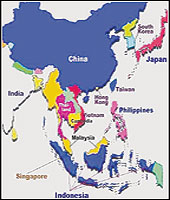
The old image of Asia with three or four little island economies- the ‘tigers’ in an otherwise poor and backward Asian landmass- has since evaporated as industrial revolution has spread across to Asian mainland; Malaysia, Indonesia, Thailand but more importantly to China and India.
Japan built its reputation as a world class power, upon the quality of skills, work ethics and organizing abilities of its people. After the Second World War, when Japanese industry had to start all over again, it bought technologies from leading American companies in chemicals, steel making, engineering, television and consumer electronics and its quality manpower did the rest.
In less than two decades, ‘higher quality and lower priced’ Japanese products were taking away not only foreign markets from the very same American companies but making big inroads into domestic market of the US and Europe as well.
The success of the industrial revolution in Asia has now moved beyond the early attractions of its cheap and abundant labour, or its large markets and is built upon the quality of skills and productivity of their human resources. Increasingly, these Asian nations are now winning larger shares of high tech and high-end markets. Even the all important R&D facilities for development of future products are now being re-located in these countries.
Not restricted to the old economy of manufacturing, the high quality of Asian skills and their productivity are also projecting some of the Asian nations into leadership positions in the knowledge-based new economy. And Asian companies are now entering the big league acquisitions in foreign markets to acquire global reach for their operations.
As a by-product of the success of industrial revolution in their countries, many companies from China, Korea, Singapore, Malaysia, Indonesia, Thailand and India, have also built up large pools of surplus funds and are busy investing abroad, acquiring companies there in their niche markets and consolidating their global positions.
There is no mystery in the miracle of development. In every single case- in Europe, North America and now Asia- the wealth and prosperity has been created by the successful handling of industrial revolution by their societies. More specifically, it is the quality of skills, work ethics, and the entrepreneurial and organizational abilities of their people that have enabled them to absorb technology, produce competitively and bring prosperity and power to their nations.
The critical resource in their transformation has not been capital but their people, and the critical decision has been whether adventurism or consolidation should define their national priorities.
In the seamless world of global finance, the old ideas of ‘scarcity of capital’ have been turned redundant by the free flow of capital across national borders. The dominant feature of the economic model of our globalized world is not the ‘scarcity of capital’, but the quality of the skills, work ethics and productivity.
But in Pakistan, our perennial fixation with ‘financial capital’ has blinded us for too long from the development of ‘human capital’ resulting in the country getting raw end of the deal at both ends. Not only does the ‘scarcity of capital’ continue to haunt the country fifty years down the road, its ‘human capital’ has also slipped down to the bottom among Asian countries as is repeatedly shown by human development reports.
The bitter truth is that no one- country or a company- wants to risk committing their major resources – money or technology- into countries whose human capital remains underdeveloped and incapable of creating wealth or value out of these inputs.
Countries that have neglected their human capital have little choice but to live by the aid, debt or donations - whatever they can get and at whatever price. There may even be some fly-by-night operators ready to take advantage of every situation. But serious and long-term money or productive technologies do not come via these routes.
The success of industrial revolution now unfolding in Asian countries has also been built upon the common foundations of developing quality human resources- irrespective of the different routes taken.
The liberal social and economic reforms introduced after the Second World War demolished old feudal and oligarchial systems, opened opportunities for all and pumped funds into development of their human resources for successful industrial takeoff of these countries.
Mao’s communism in China, Nehru’s socialism in India and Mahathir’s ‘Affirmative Action’ in Malaysia also, in their own ways, carried out similar social and economic reforms that are widely credited by respected scholars for laying the foundations for successful industrial takeoff in these countries.
The only thing missing then was the capital and technology which poured in to utilize their quality human resources when their governments opened the economies to foreign investment: China in 1970s, Malaysia in 1980s and India in 1990s.
Industrial revolution has been knocking on the doors of Pakistan for over a decade now. What is holding it back is not the ‘scarcity of capital’ but the scarcities of other kind- of its human capital; consensus on national priorities; opportunities for all; and the rule of law.
As Pakistan seriously applies itself to removing these scarcities, the doors to industrial revolution will open here as well; and let us rest assured that if it does so, the scarcity of capital, like in other countries, would become a non-issue.
When the capital and technology from around the world is chasing the many opportunities here, and not the other way around, it will be a sure sign that industrial revolution has finally arrived in Pakistan.