197
197

“I WAS standing and he came in a group and shook hands with me,” remembered Gen Pervez Musharraf. “…He asked me how I was, I asked him how he was. That’s very good.”
The script wasn’t quite Nixon in China, but we take what we can get. In the fall of 2005, Pakistan’s generalissimo went to New York and shook hands with Israel’s Ariel Sharon — soldier, statesman and blood-sodden war criminal.
The romance may even have taken off but for the general’s dwindling capital. Over the next three years, Musharraf would drive Balochistan to disaster, persecute judges, ramp up missing persons, and escort Asif Zardari out of prison and into the presidency.
Mr Sharon, for his part, sank into a coma, the kind of end he had never afforded the women and children his militias had hacked to death in Sabra and Shatila, their bodies arranged in garbage piles. The Musharraf-Sharon meeting proved little more than a sly handshake, if between two of America’s most beloved dependents.
Yet here we are again: every 20 years or so, the deepest parts of our deep state call for fresh thinking. True believers take up the cause of the state of Israel — if ‘state’ can be taken to mean the world’s most ferocious apartheid project. While every green passport dubs Israel the forbidden land, rumours of recognising it recur.
Rumours of recognising Israel keep recurring.
“There is pressure,” the prime minister told an interviewer some two weeks ago, “because Israel has a large impact on America,” but that he’d never recognise it (the source of the said pressure was left unsaid). There then followed a series of trial balloons, almost exclusively by pro-establishment voices, urging recognition.
Their reasons remain hollow. First, there’s the loopy notion, advanced more by Orientalist romantics than scholars at home, that Pakistan and Israel are long-lost twins: promised lands built on religion and threatened by enemies.
They aren’t. Pakistan was a mass movement for the subcontinent’s Muslims to breathe free, and it became the world’s largest Muslim-majority state at birth. “Pakistan was of course nothing like Israel in this particular respect,” wrote historian David Gilmartin, “for the areas that became Pakistan were already occupied by tens of millions of the Muslims in whose name the state was created.” Zafrullah Khan, the Quaid’s foreign minister, opposed Palestine’s partition for the same reasons at the UN.
By contrast, Israel was the result of a settler militia driving out 700,000 Palestinians from their homes, and cleansing many more from the adjoining areas — Mr Sharon participated by lobbing grenades and getting shot in the groin and stomach. The cry of ‘a land without a people for a people without a land’ is a Zionist fairytale; just as calling Pakistan a ‘Muslim Zion’ is, in the words of Mr Gilmartin, an act of historical erasure.
Next comes that saying as old as death: ‘nations have no permanent enemies, only interests’. Our sages wrongly credit this to Henry Kissinger, a man whose brilliant realism enabled death squads in Chile and rivers of napalm in Vietnam (the quote is actually from the long-forgotten Lord Palmerston). But even leaving aside how perverse the Kissinger school has been, it may be best to examine what interests stand to benefit and where.
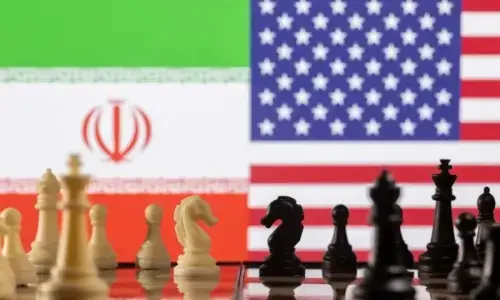
Some suggest greater closeness to Washington, though this has been a placebo at the best of times. Others point to the UAE and Bahrain’s push for recognition, driven in part by the Arab states’ opposition to Iran. But Pakistan has nothing to gain and everything to lose from siding with either Riyadh or Tehran: Islamabad shares strategic ties with one country, and a massive land border with the other. Winking at Israel would upset Iran, to no great gratitude from the Gulf.
Finally, recognition would tear Pakistan’s single-most salient cause to pieces: the right to self-determination for the Kashmiri people. Not for nothing are Modi’s crimes in India-held Kashmir most likened to a West Bank formula, in tribute to Israel dropping white phosphorous on screaming civilians. If Hindutva was directly inspired by the Nazi dream, Israel has proven its most ironic mirror.
In sum, Pakistan will win no new friends, risk losing the ones it already has, enrage its people, condemn the Palestinians to oblivion, and cede the Kashmiris to their occupiers, all to recognise a settler colony that only ever expressed interest in bombing Kahuta in 1984. Until the emergence of a viable Palestinian state — loath to happen anyway under Netanyahu’s coalition of maniacs — Pakistan has no business weeping for Zion.
As is so often the answer, it would be best to return to the ideals of Mr Jinnah instead. It was soon after Israel’s declaration of independence that its founder, David Ben-Gurion, reportedly fired off a telegram to establish diplomatic relations with Pakistan. The Quaid didn’t reply; nor did he have to.
Mr Jinnah knew the difference between oppressed and oppressor.
The writer is a barrister.
Published in Dawn, November 28th, 2020