
ALL eyes in Pakistan must be on Iran because of the likely crippling consequences of an outbreak of hostilities between the US-Israel coalition and the Persian Gulf Islamic Republic, with millions here and abroad asking when and if Trump will pull the trigger.
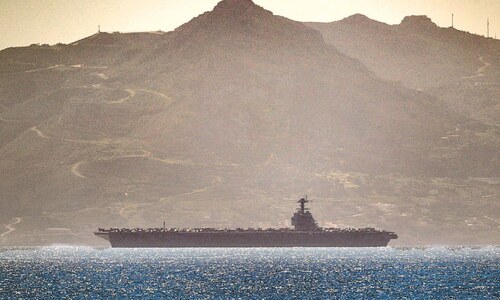
Many analysts believe that the level of US military mobilisation ordered by President Donald Trump and the assembling of what he calls an ‘armada’ in the Gulf can’t be just to threaten or intimidate Iran but is actually part of preparations to attack it. Israel and its American supporters who have given Trump hundreds of millions of dollars in campaign funds apply their own pressure.
Despite its overwhelming technical, numerical and resource advantage, is American military might enough to deliver mass-scale destruction in Iran in the shortest possible time? Even if accompanied by, reportedly, hundreds, even thousands, of Mossad-CIA-MI6 (Israeli, US and UK) agents and operatives on the ground — all carefully cultivated, funded and armed to play fifth columnists? This is the question Trump must be addressing.
America’s appetite for either prolonged conflict or ‘boots on the ground’ is near zero, especially in Trump’s MAGA heartland. With mid-term Congressional elections due on Nov 3, a little over eight months away, the US president knows what making the wrong call on Iran could mean for the remainder of his term in office if his obedient-subservient Republicans lose their House majorities.
Iranian planners know they can’t win a war against the US. But they say they plan to inflict a heavy cost on the US for any unilateral aggression.
The US may not be dependent on Gulf oil, unlike China and East Asia and even Pakistan, but 20 per cent of the global oil supply passes through the Strait of Hormuz daily. If the US can’t quickly clear the area of Iranian naval assets — including of the Islamic Revolutionary Guard Corps (IRGC) — comprising high-speed missile boats, shore-based fortified missile batteries, and missile launchers on islands dotting the Gulf, besides Iran’s ability to mine the narrow waterway, then any disruption will lead to a rise in oil prices.
The longer the disruption, the higher the oil prices. Where this can devastate economies such as Pakistan’s and cause headaches for even China — 15pc of whose oil needs are met by discounted Iranian imports — experts say that a months-long campaign can push oil prices up to $150 a barrel. Such an oil price hike will hammer the global economy and the US can’t remain immune to its effects.
Blocking the strait is just one step the Iranians could take if they retain the military capacity in the days and weeks after the start of a possible attack during which the US military claims it can carry out 800 sorties a day. Sea- and land-based missiles will be in addition, as will Israeli air attacks.
Iran could retaliate by targeting not just US military bases but also part of the Arab Gulf oil and gas infrastructure, impacting supplies. One can be sure that if the US does decide to attack Iran, mainly at the behest of Israel and some of its two-faced regional allies, it will have factored in Iran’s military capability and devised a plan on how to knock out Tehran’s missile stockpiles and launch sites quickly.
The memory of last year’s 12-day war is still fresh; faced with an Iranian missile barrage that breached sophisticated multi-layered missile defence shields to hammer Israel. The latter country is reported to have asked the US to secure a ceasefire.
One can be sure in the months since that the US-Israel coalition has done its homework, strengthened missile defence shields and worked on identifying and better targeting Iran’s missile launchers, many of which are said to be in deep underground bunkers but still highly mobile.
Although China and Russia have refrained from any openly declared military supplies/upgrades, there are suggestions in the independent media (not in the Western legacy media framework) that the Iranian military, like Pakistan’s, has now completely transitioned to the Chinese BeiDou satellite system from the US Global Positioning System (GPS).
This has two advantages. The first is the West’s difficulty in jamming it, and secondly, its targeting is said to be better compared to that of GPS in some areas. There are some reports that Iran now also possesses a datalink for military communications and targeting similar to Pakistan’s Link-17 which the latter state used to devastating effect in last year’s conflict with India.
Iranian planners know well that they can’t win a war against the US. But they say they plan to inflict a heavy cost on the US for any unilateral aggression. How high that cost can be and how much of it is achievable by a long-sanctioned Iran is something Trump would be receiving briefings on.
Israel wants to devastate Iran’s central authority and turn the country into another Libya or Syria so that it loses its ability to challenge the settler-colonial state. Fragmentation and a civil war-like situation may remove the threat to Tel Aviv but the latter’s proxies can threaten states like Pakistan, unleashing hitherto unknown dynamics.
Western media is abuzz with talk of an attack as early as this weekend. But, as we speak, Russian, Chinese and Iranian (including the IRGC) navies are carrying out exercises in the Strait of Hormuz. China has made it clear many times that it has no appetite for military conflict and will focus on economic growth and global trade integration through its Belt and Road Initiative.
Russia is preoccupied with its war in Ukraine and the US might leverage that conflict to secure Russian neutrality. However, with both major powers carrying out naval manoeuvres bang in the middle of a conflict zone, it isn’t clear what their reaction would be if their assets suffer collateral damage; they won’t be targeted. This may dictate the timing of the US decision, perhaps the decision itself.
The writer is a former editor of Dawn.
Published in Dawn, February 22nd, 2026