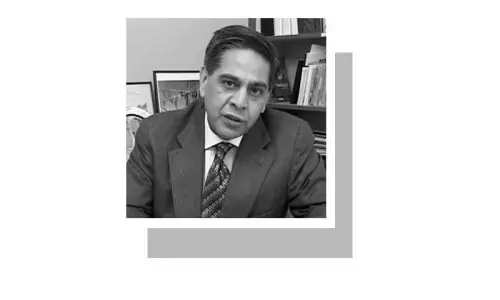
KARACHI, Sept 18: Rich tributes were paid to the late Hasan Abidi, journalist, poet, writer and rights activist, at a condolence meeting at the Karachi Press Club on Saturday. Speakers at the meeting organized jointly by the Progressive Writers’ Association, the Awami Adabi Anjuman and the Karachi Press Club, said he worked till the last and submitted his weekly literary column at Dawn a day before his death. He died on Tuesday, and his column, along with the news of his death appeared on Wednesday.
Former editor-in-chief of Dawn Ahmad Ali Khan, who presided over the meeting, said Hasan Abidi had a multi-dimensional personality. He was a journalist, writer, poet, political analyst and trade unionist and sometimes it was difficult to understand how he did so much work and that also of diverse nature.
He said Hasan Abidi started his carrier from Urdu journalism. After leaving Mashriq, he shifted to English journalism and joined Dawn.
Mr Khan said that although Hasan Abidi had seen some hard times, he always remained calm and composed. He had been put into prison but never complained much about it.
Other speakers said Hasan Abidi was soft-spoken, hardworking, shy, but not a recluse. His journalistic engagements never allowed him to make full use of his poetic potential. He concentrated on poetry at a late stage but even then he has left behind three collections, much of which is a poetic documentation of social and political conditions. His works are an enduring contribution to Pakistani literature.
He was an ardent progressive and advocated his ideas through his writings and work as a political activist and trade unionist.
He started his journalistic career from Lahore where he joined daily Afaq in 1957. Later he moved to Lail-o-Nahar where he worked with Faiz Ahmad Faiz, Sibte Hasan and Ashfaq Ahmad. Then he came to Karachi and worked for daily Mashriq’s Akhbar-i-Khawateen magazine before joining Dawn.
He was prolific writer and boldly explored social themes and highlighted issues being faced by the poor. More than once he was put in prisons, including the notorious Shahi Qila in Lahore, for his political and trade union work and also under the Rawalpindi Conspiracy Case.
The speakers said that Hasan Abidi was influenced by Marxism and remained committed to it till his last days and never yielded to any pressure or influence. He was a voice for the voiceless and he worked for a society free from prejudice.
He was a man of integrity and though soft spoken, he had the courage to speak out and write the truth without caring for consequences. He was a selfless man, who always struggled for the good of the community and society.
The speakers included Farhad Zaidi, Abdul Hameed Chapra, Hussain Bukhsh Thebo, Sarfaraz Ahmad, Father Pascal Robert, Naqqash Kazmi, Dr Sagar Abro, Muslim Shamim, Tashna Barelvi, Dr Jaffer Ahmad, Abdul Khaliq Junejo, Najamul Hasan, Iqbal Alvi and Najeeb Ahmad.
Poetic tributes were also paid to the veteran journalist, poet and rights activist at the meeting, conducted by Fazil Jamili.