MY friend recently shared a video of a black employee being publicly reprimanded by her boss, for leaving her office for 40 minutes every day to use the restroom in a neighbouring building; there were no toilets for black people in her building.
Watching this colour-coded toilet segregation conjured in my head, George Floyd’s final moments, gasping for breath, face wedged between a street surface and a policeman’s knee. His tragic plea, “I can’t breathe”, wasn’t mere supplication; there was something real, relatable about it.
Both instances drove home an inconvenient truth: our world is structured through a human pyramid; some colours, religions and sexualities occupy a higher lattice on this pyramid. Floyd’s plea became a metaphor for the choking condition of minorities on the lowest rungs.
The primal fear his tragedy evokes outstrips previous protests. It’s not just minorities flailing to convince the majority that black lives matter. This feels exigent, epochal. Without drawing attention away from systemic American anti-blackness or conflating racial profiling with religious pigeonholing, this crescendo resonates with millions outside the status quo, making them question when they surrendered their right to be human. People of colour, misunderstood religions, marginalised sexualities, dreading: ‘Am I next?’ Whilst this catastrophe demands allyship towards black lives, it offers an opportunity to recognise other forms of oppression and provides a toolkit to rise against it.
Floyd’s plea became a metaphor for the condition of minorities.
At various junctures, people have felt suffocated. For centuries, Muslims have comprised one such slurred category. Then 9/11 happened, time-stamping and popularising a term for it: Islamophobia. Terror, trepidation, torture; suspicion of all things Islamic; awaiting verdicts at visa centres and immigration; hoping a Muslim-sounding name doesn’t appear after a terrorist attack; discarding symbols sketching a threatening zealot: beards, veils, birth-names like tattoos; aligning with ‘cool’, ‘modern’ opinion to isolate from the ‘fundamentalists’.
Such expediently marshalled stigma rests on carefully carved tropes, relegating Muslims to a homogenous community: one fanatical Muslim, one violent brand of faith, united by a totalitarian impulse. This Muslim ‘agenda’ is seen as threatening a creeping Sharia, conspiring to convert the West into an omnipotent Muslim landscape; a scenario to be thwarted. Of course, terrorism doesn’t have a religion, but such generalisations can be handy and instrumental. If repeated enough times, they become credible too.
The results, therefore, are unsurprising — just this past year, roadside lynching, university assaults, open prisons — countless instances of despotism against a so-called radical religion. The chokehold imploration of Muslims resembles Floyd’s: they can’t breathe.
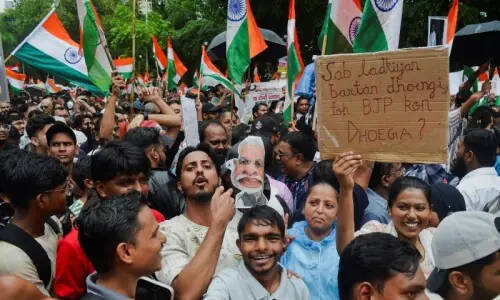
But such brutality appears counter-intuitive; how can secular democracies suddenly turn autocratic? Ironically, after Partition, India parked itself at a careful distance from Pakistani dictatorship and ‘extremism’. More recently, however, when emboldened Hindutva supremacists are caught on camera — inciting a tinderbox nation along religious fault lines — there’s no longer the need to hide what perhaps lay buried beneath.
Momentarily, it seemed the ‘Incredible India’ story supplied universally, may be squared with the havoc wreaking in its streets and alleys. Yet, what tangibly changed? Whether such religious nationalism always existed and was finally undressing itself or if this phenomenon was recent, is secondary. What matters is that the effort to highlight these violations flew in the face of a global system predicated upon profit. The burning bottom line implies: economics trumps humanity.
A revolution is not a one-time event but for commercial interests to stop outweighing human rights, the corporate contract between global powers must be reconnoitered. To make this happen, the move from window-dressing diversity to a full-blown alliance architecture is critical. How can we, as individuals, contribute? Through allyship, which is a verb, not a noun. It isn’t meant to place your feelings centre stage or amass self-glory by shielding another. It’s about listening, standing up, carrying the weight when it isn’t about you; tackling overt violations and clandestine instances; regularly using classrooms, boardrooms to talk about this open secret; reworking syllabi; re-examining hiring and promotions; holding ourselves accountable so the movement doesn’t lose steam; calling out every moment when someone fears: ‘Am I next?’ or worse still, pleads ‘I can’t breathe’.
Let’s face it, we are mostly inactive, neutral, complicit. Floyd, however, wanted to touch the world. Whilst it isn’t ideal that he moved humanity in tragic death, he left us with a choice — to annihilate this manufactured pyramid of being human and make this a story of redemption or resign and settle for remorse. The latter is our standard pick.
The writer works at New York University’s campus in Abu Dhabi.
Published in Dawn, July 9th, 2020