Seasonal loquat fruit ripens in orchards


 0
0
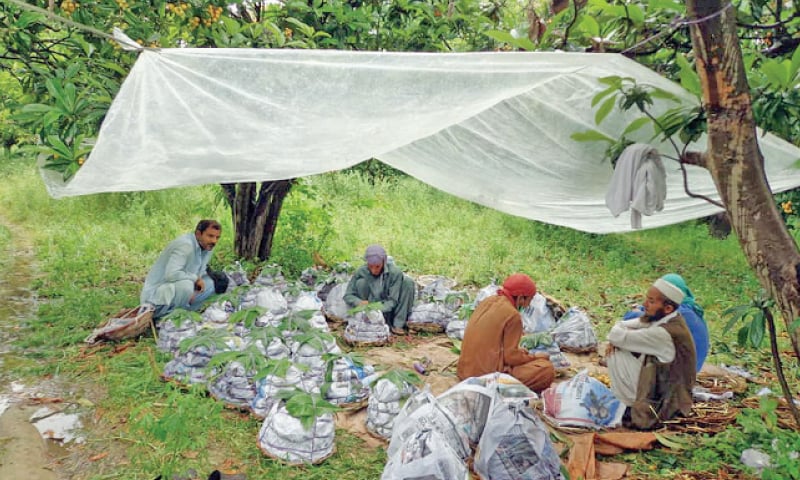

TAXILA: The seasonal fruit of summer, loquat, has ripened in the orchards of Punj Khatta and Wah Garden and started flooding stalls in markets of different cities.
Farmers also set up makeshift stalls outside orchards to provide fresh production to fruit lovers.
Production of the sweet-and-sour fruit this year is better due to massive rain. Besides citrus and lychee, loquat is another item from the food basket of Punj Khatta. Orchards of loquat alone in this area spread over 190 hectares with 1,884 tons of annual produce. Roadside makeshift kiosks on Taxila’s Haripur road, Hattar road and GT Road near Wah Garden are a source of livelihood for local farmers, which attract the attention of fruit lovers and travelers on these inter-district routes.
Last year, a five-kilogramme carton of loquat was available in the local market for Rs300 to Rs350 but this year the same quantity is being sold at Rs550 to Rs600.
Responding to a query, Sultan Khan, a local farmer said: “Cost of fertiliser, transportation, labour and packing witnessed an unprecedented increase, which has resulted in the increase in price.”
Another farmer from Wah Garden, Irfan Khan, said this year’s crop is better than last year and farmers were expecting to earn better income during this season.
Talking to Dawn, Jameel Khan, a contractor from an orchard in Usman Khattar, said: “The season of loquat fruit lasts for roughly one and a half months and fruits of this area are in high demand in the markets of Islamabad and Lahore.”
Loquat orchards near Wah Garden spreading over seven to 10 acres also happen to be among the most popular picnic spots for tourists especially during summer because of the chilling water in streams. According to Imran Khan, a resident of the area, a tree or two of loquat are very common in the courtyard of every house in Wah Garden and adjacent villages.
Assistant Director (agriculture) Tahir Mehmood said: “Loquat is an exotic fruit which is rich in vitamins A, B, and C. This fruit also contains many other nutrients including carotenoids, antioxidants, flavonoids and phenolics.”
Like other parts of the country, loquat in Punja Khatta grows on evergreen small trees or shrubs, which are of different sizes ranging from 20-30 feet in height, he added.

“This fruit was found 2,000 years ago in South China. Later, it travelled to Japan around 900 years ago and then reached the subcontinent. It is also found in Mediterranean countries, South America and Australia,” horticulturist Sohail Ahmed Khan told Dawn.
Mr Khan said reportedly there were over 800 varieties of loquat around the globe.
According to Pakistan Academy of Family Physicians President Dr Syed Asad Ali, loquat consumption is recommended by herbalists due to its therapeutic potential for asthma, anti-inflammatory, antidiabetic, antioxidant and anticancer properties.
He said: “As the world is badly affected by Covid-19, this fruit may be considered as a God gifted cure to this disease as this fruit is used to strengthen the body’s immune system because it is rich in vitamin C.”
Physician Dr Shumila Irfan said: “Vitamin C initiates formation of white blood cells which act as a wall against pathogens. The growth and repairing of tissues is done by a compound known as collagen which is also produced with the help of vitamin C.”
According to herbalist, Hakim Mohammad Saad, the leaves of loquat are a magical cure for diabetes and their tea could bring down sugar levels.
He said this fruit enhances the immune system as its nutrients include pectin, iron, potassium, vitamin A and C along with fiber.
The fruit acts as a sedative and is eaten to stop vomiting and thirst, he said.
Published in Dawn, April 29th, 2020