Law ministry endorses IHC order for release of over 700 under-trial prisoners


 2
2


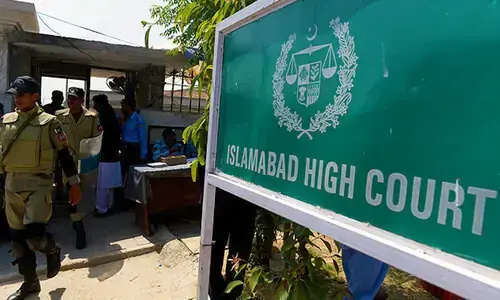
ISLAMABAD: The law ministry endorsed the recent order of the Islamabad High Court (IHC) for the release of over 700 under-trial prisoners (UTPs) on bail.
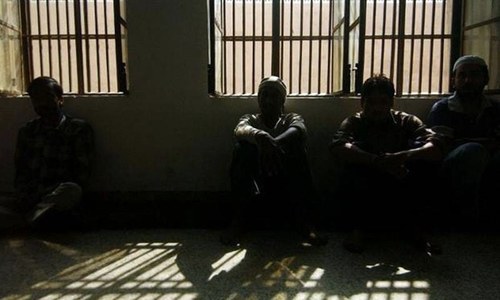
While hearing a petition seeking implementation of the order, IHC Chief Justice Athar Minallah observed that “under-trial prisoners who are involved in cases pending before the courts within the jurisdiction of this court are incarcerated in the Central Prison, Rawalpindi. The said prison is overcrowded and the living condition therein is intolerable.
Most of the prisoners do not have access to the courts because they cannot afford to engage professional services of enrolled counsel. Many in the first place should not have been incarcerated. It is a constitutional obligation of this court to ensure that fundamental rights are safeguarded. There are serious concerns regarding welfare of the prisoners, particularly their right to life”.
The high court, however, deferred the implementation of its order when it was apprised that the Supreme Court had constituted a five-member larger bench to hear a petition filed against the release orders of the UTPs.
Supreme Court to hear a petition against the high court orders
Chief Justice Minallah, while referring to a news item published in an English daily which claimed that the government was not happy with the release of UTPs by the IHC, inquired from law secretary Khashihur Rehman about the authenticity of the news.
Mr Rehman said that the government has no reservations on the release of UTPs from the overcrowded jail. He, however, did not give any plausible reason as to why the law ministry, which otherwise promptly contradicted even routine news reports, did not issue a clarification about the above-mentioned report. He sought some time to look into the matter.
Chief Justice Minallah directed the law secretary to submit a report regarding steps taken to ensure observance of law. He pointed out that Pakistan has slipped from 117 to 120 out of 128 countries on the Rule of Law Index prepared by World Justice Project that is acknowledged as the leading sources for original and independent data on the rule of law.
“This ought to raise serious concerns,” he observed, adding that the framework of the Rule of Law Index is based on eight factors, including constraints of government powers, absence of corruption, open government, fundamental rights, order and security, regulatory enforcement, civil justice and lastly criminal justice.
“The criminal justice component includes prison i.e. questioning whether the correctional system is effective in reducing criminal behaviours. Most of these components are within exclusive domain of the executive authorities and the courts are dependent on its effective implementation/performance,” states the court order.
The ministry of law and justice was asked whether the federal government had considered the Rule of Law Index, 2020.
The law secretary requested for time to submit a report.
The court also inquired whether the constitutional requirement of submitting a report by the President before the Parliament on the observance and implementation of the Principles of Policy to ensure inexpensive and expeditious justice was fulfilled? The law secretary again sought time to file the report.
The chief justice observed that since most of incarcerated UTPs cannot access the courts because of financial constraints it is the duty of the executive under various laws to take action so that inmates are not unnecessarily kept in prison.
It is the duty of the prosecution and executive authorities to ensure that every prisoner has access to the courts and such duty is an integral part of the constitutional obligation to ensure inexpensive and expeditious justice, he added.
Subsequently, the court asked Additional Attorney General Tariq Mehmood Khokhar and Advocate General Niazullah Khan Niazi to assist it regarding powers of the constitutional courts having regard to the constitutional obligation of the state of ensuring inexpensive and expeditious justice. “They are also expected to suggest a mechanism in this regard.”
The matter was adjourned till April 24.
Published in Dawn, March 29th, 2020