Trump tests negative for virus as US expands Europe traveller ban


US President Donald Trump has tested negative for the novel coronavirus, his physician said on Saturday, following concerns over his exposure to a disease that has paralyzed the globe.
Trump agreed to the test after coming in contact with several members of a Brazilian presidential delegation visiting his Florida resort who have since tested positive for the virus.
"This evening I received confirmation that the test is negative," the president's physician Sean Conley said in a memo.
"One week after having dinner with the Brazilian delegation at Mar-a-Lago, the President remains symptom-free," he said.
Trump, 73, had dismissed concerns over his exposure to the disease which has killed at least 51 Americans and upended the rhythm of daily life across the country, with millions working from home and schools shuttered.
New York, the most populous US city, saw its first coronavirus death on Saturday, as store shelves were stripped bare after days of panic buying.
"I have been through Hurricane Sandy [...] through 9/11, I have never seen shopping like this," said Larry Grossman, manager of a Manhattan supermarket.
Vice President Mike Pence on Saturday announced a further restriction on travel to the United States, saying a travel ban imposed on European nations over the pandemic would be extended to the United Kingdom and Ireland Tuesday.
Trump advised against non-essential travel, and said officials were considering imposing travel restrictions within the United States.
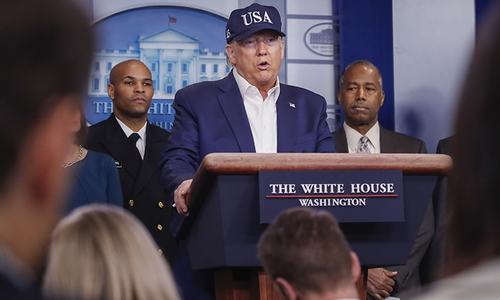
"If you don't have to travel, I wouldn't do it," Trump said at a White House news conference. "We want this thing to end. We don't want a lot of people getting infected."
Trump declared a national emergency on Friday in what critics say was a long-delayed admission of the gravity of the crisis, freeing up some $40 billion in disaster relief funds.
Late Friday, the US House of Representatives passed a bill — crafted by Democrats in consultation with the Trump administration — to provide billions of dollars for free virus testing, emergency paid sick leave and family leave related to the epidemic.
Supported by Trump, it is expected to easily pass the Republican-controlled Senate next week.
News of Trump taking the test marked a further turning point, after days of resistance to the suggestion.
An end to hand-shaking
The coronavirus pandemic has claimed more than 5,700 lives in some 137 countries.
Repeatedly attacked for sending out mixed signals on the health crisis, the president raised eyebrows on Friday when, contrary to medical advice, he was seen shaking hands as he gathered his coronavirus response team at the White House.
On Saturday, he blamed habit — "people put their hand out [...] you don't think about it" — but said it would have to change.
"Maybe people shouldn't be shaking hands for the long term," said Trump, a self-declared germophobe, "because it does transmit flu and other things".
Trump's virus test came after not only contact with the Brazilian delegation, but also US lawmakers and political leaders who have gone into self-quarantine over potential infection.
Republican National Committee chairwoman Ronna McDaniel was on Saturday awaiting results of a virus test after she came down with flu-like symptoms.
She reportedly attended an event in Florida with Trump on Monday and flew back to Washington on Air Force One.
A broader travel ban
On Saturday a 30-day US ban took effect on all travel from the EU's Schengen border-free zone, part of a global clampdown on travel to curtail the virus.
Pence said the ban — which notably excluded Britain and Ireland — would include both countries as of midnight EST on Monday.
"Americans in the UK or Ireland can come home. Legal (US) residents can come home," Pence said.
Trump also aimed a new jab at the US Federal Reserve, saying he wanted it to be "much more proactive" in moving to protect Americans from the widespread economic dislocation caused by the pandemic.
But the president — wearing a navy blue USA cap — seemed otherwise subdued during Saturday's briefing, uncharacteristically offering praise to Democrats including House Speaker Nancy Pelosi.
Pelosi said she was "proud" to have reached an agreement on the relief package after days of tense talks with the White House.
Trump also tweeted that he had a "nice conversation" with Canadian leader Justin Trudeau and that it was "great to hear that his wonderful wife Sophie is doing very well". Trudeau has been telegoverning since his wife was diagnosed with COVID-19 on Thursday.