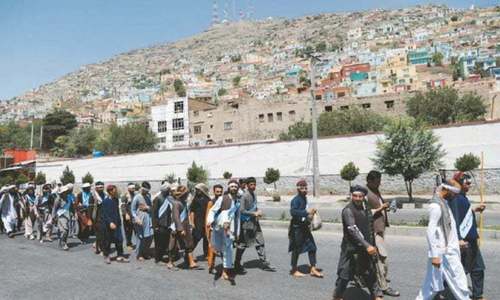
KABUL: A partial truce marking a potential turning point in Afghanistan’s gruelling war appeared to be holding on Saturday, with only isolated attacks threatening to mar a process that drew jubilant civilians across the shattered country onto streets to celebrate.
The Taliban, US and Afghan forces have all agreed to a so-called “reduction in violence”, marking only the second lull in fighting since the US-led invasion of 2001.
“It is the first morning that I go out without the fear of being killed by a bomb or suicide bomber. I hope it continues forever,” said Kabul taxi driver Habib Ullah, while in other parts of the country people danced in the streets after the truce kicked in at midnight.
However in Balkh province in the north, Taliban fighters attacked a district headquarters near the provincial capital of Mazar-i-Sharif, killing two Afghan soldiers, a local official said. There were also reports of a violent incident in central Uruzgan province.
General Scott Miller, who leads US and Nato forces in Afghanistan, did not directly address those incidents, but stressed that Western forces would continually monitor the situation.
The UN mission in the country says more than 10,000 people were killed or wounded last year alone
“We’ve stopped our offensive operations as part of our obligations,” Miller told reporters. In the event of any breaches of the truce, he said the US would communicate with the Taliban through various channels set up in Doha, where the militants have a political office.
“As more days go on we will have a better understanding of what trends are,” Miller said. “Very clearly this is a conditional effort, this is a trial period.”
The partial truce is expected to set the conditions for Washington and the militants to sign a deal in Doha on February 29 that could, ultimately, pull US troops out after more than 18 years and launch war-weary Afghanistan into an uncertain future.
A successful week would show the Taliban can control their forces and demonstrate good faith ahead of any signing.
It also gives a much-needed respite to civilians, who have long borne the brunt of the bloody conflict. The UN’s Afghanistan mission said on Saturday that more than 10,000 people had been killed or wounded in the war in 2019 alone.
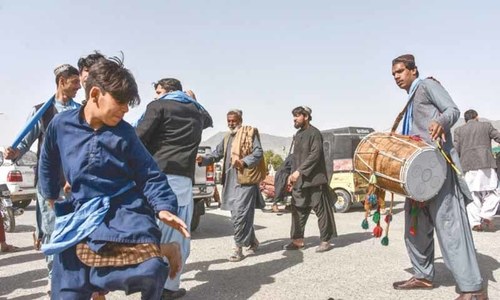
In Kandahar in the south, considered the Taliban heartland, and the eastern province of Jalalabad, dozens of Afghans could be seen dancing the attan — a traditional Pakhtun dance — in the streets in celebration overnight.
In Kabul, which for years now has been one of the deadliest places in the country for civilians, those who spoke to AFP were more wary.
Shopkeeper Emamuddin, who like many Afghans goes by one name, said Afghans wanted peace “whatever it takes”.
“A week of no violence will pass in a blink of the eye,” he said. “They should find a long-lasting solution for this country’s problem.”
Details of how exactly the reduction in violence will work have remained scant. The US has said there is an “understanding” for a “significant and nationwide reduction in violence across Afghanistan”, while Afghan security forces will remain “on active defence status” during the week.
Highlighting the partial nature of the truce, Taliban spokesman Zabihullah Mujahid stressed it was “not a ceasefire”. “The reduction in violence covers provincial capitals, army HQs, divisions, battalion centres and foreign forces compounds,” he said on Twitter.
Any truce comes fraught with danger, and analysts warn the attempt to stem Afghanistan’s bloodshed is laced with complications and could fail at any time.
Since the US invasion in 2001 there has only been one other pause in the fighting — a surprise three-day ceasefire between the Taliban and Kabul marking the festival of Eid in 2018. Afghans responded joyfully, with Taliban fighters, security forces and civilians hugging, sharing ice creams and posing for selfies in previously unimaginable scenes.
Perhaps in a bid to avoid such scenes, the Taliban have instructed their fighters to stay away from government-controlled areas during the truce, but a senior Afghan security official said the insurgents would be welcome with “open arms”.
Washington has been in talks with the Taliban for more than a year to secure a deal which would see it initially reduce troop levels from approximately 12-13,000 to an expected total of about 8,600. In return, the Taliban would give security guarantees and a promise to hold peace talks with the government in Kabul.
Conflict in Afghanistan has forced hundreds of thousands of Afghans to flee into Pakistan, where they are monitoring developments in their homeland closely. “I am hopeful the peace agreement will bring peace in Afghanistan and we will be able to return,” said Amir Khan, a father of six who fled Afghanistan 35 years ago and now lives in Peshawar.
“We were not given any chance to become Pakistanis, so better to return to our origin.”
Published in Dawn, February 23rd, 2020