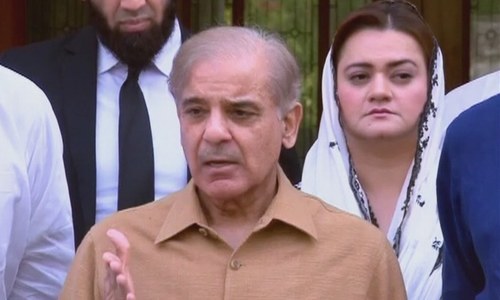
'Relief package': Govt announces subsidies to tackle inflation

The federal cabinet on Tuesday approved a relief package in order to "stabilise prices and provide relief to public", prime minister's aide Firdous Ashiq Awan said.
The decision was one of many taken by the federal cabinet in its meeting today. The special assistant to the prime minister (SAPM) on information and broadcasting was addressing the media after the meeting.
In light of the ongoing sugar crisis, the government has decided to lift, with immediate effect, restrictions on the import of sugar in order to stabilise prices, SAPM Awan said.
A framework is being prepared to lift regulatory duty on imported sugar, she added. The export of sugar, meanwhile, has been banned.
The announcement comes a day after the Economic Coordination Committee's (ECC) ratified Prime Minister Imran Khan's decision to slap a ban on the export of sugar in order to "stabilise domestic prices". The ECC had not, however, approved the premier's decision to import sugar through the private sector, noting that "adequate stocks" of the commodity are available in the country.
In today's meeting, the government also decided to provide a monthly subsidy of Rs2 billion to utility stores for the next five months so that the prices of essential food items including wheat, sugar, rice, pulses and ghee can be curbed. The cabinet also agreed that the sales and availability of the foodstuffs should be monitored strictly.
"Utility stores have been directed to sell a 20-kilogramme bag of wheat at Rs800, sugar at Rs70 per kg, ghee at Rs175 per kg while rice and pulses will be sold at 20 per cent reduced price," said Awan.
Awan also announced that the Utility Stores Corporation (USC) will issue ration cards before the holy month of Ramazan which would provide a discount of 25-30 per cent on essential items to deserving people.
The SAPM said that the government will open 2,000 "youth stores" in collaboration with USC. The stores will be part of the Kamyab Jawan Programme, she said, adding that the initiative will create jobs and ensure the provision of commodities at cheap prices. The Kamyab Jawan Programme will provide interest-free loans for the project.
USC will also open 12 cash-and-carry stores in major cities of the country to "stabilise prices".
The global health emergency caused by the spread of the novel coronavirus, which originated in the Chinese city of Wuhan, also came under discussion during the meeting. The cabinet was briefed on the measures being taken by the health ministry to prevent the spread of the novel coronavirus as well as the situation of the Pakistani students currently trapped in Wuhan.
Haj policy
This year's Haj quota, so far, is 179,210 persons, Minister for Religious Affair Noorul Haq Qadri, who was addressing the media alongside Awan, announced. He said that Saudi Arabia may increase the quota if there was more capacity.
Qadri said that this year, 60 per cent of the pilgrims will travel through the government Haj scheme, while 40pc will travel through private tour operators.
He said that the Haj policy had been delayed because the prime minister wanted to make sure that the pilgrimage was as economically viable as possible. After much deliberation, the government had approved a package of Rs490,000 for pilgrims from the north region and Rs480,000 for those from the south region.
He attributed the increased cost of Haj to a rise in PIA airfares and devaluation of currency.