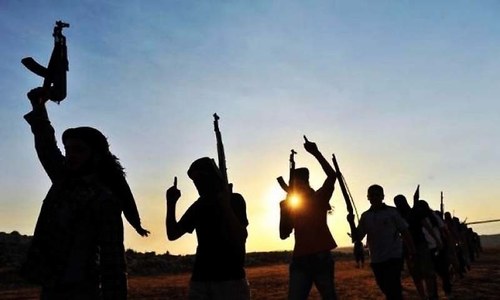
PAKISTAN is making reassuringly steady progress out of the grip of militancy. According to the latest report on terrorism-related violence in 2019 by the Centre for Research for Security Studies, 518 people died in around 370 terrorist attacks last year.
The number of fatalities — which includes civilians, security and government personnel, and militants — is 30pc less than in 2018, when 739 lives were lost in approximately 400 attacks. The extent of improvement is even more starkly illustrated when compared with terrorism-related fatalities in 2013 that, as per the CRSS, numbered over 4,600.
Suicide attacks have similarly shown a precipitous decline, plunging from 26 in 2018 to nine last year — with 295 and 56 deaths, respectively. 2019 also marks the first year since 2004 in which no drone strike took place. Of the 141 militants arrested last year, the highest number was from the TTP (32) followed by the Lashkar-i-Jhangvi (11).
The conclusion is incontrovertible: after nearly two decades of gut-wrenching violence that claimed thousands of innocent lives and left a trail of devastation in its wake, Pakistan has turned a corner. This has much to do with the kinetic operations that the security forces have undertaken in the northern areas.
Consider the rate of decline in civilian fatalities: in 2014 — the year that Zarb-i-Azb was launched — they numbered 2,590 — including the 141 who perished in the APS massacre. In 2015, by which time terrorist groups like the TTP were under pressure and many of their fighters on the run, 1,146 civilians had been slain.
However, the seeds of militancy will continue to produce their deadly harvest until each and every vestige of their existence has been rooted out. That takes patience and diligence from all segments of society. It was only last week that the Punjab CTD, after an operation in Gujranwala, claimed to have busted a media cell of Al Qaeda in the Indian Subcontinent.
A few months ago, the Sindh CTD announced it had busted a splinter cell of the AQIS in Karachi. According to the law-enforcement agency, the group comprised individuals who had returned from Afghanistan and were planning to carry out attacks in the city.
Earlier, on March 22, there was an assassination attempt on well-known religious scholar Maulana Taqi Usmani, in which three of his aides were killed. There are also geopolitical factors that in tandem with ideological objectives can spill over into our country, such as when Pakistan became a theatre for sectarian violence in a proxy war between Saudi Arabia and Iran in the 1980s.
Presently, the never-ending strife in Afghanistan and the foothold that the militant Islamic State group has found there, particularly in provinces contiguous with Pakistan, are cause for concern. We are fighting an implacable enemy and, while the latest figures are encouraging and show that the country is headed in the right direction, complacency is not an option.
Published in Dawn, January 2nd, 2020