China says only it can rule on Hong Kong constitution


China insisted on Tuesday it alone held the authority to rule on constitutional matters in Hong Kong, as it condemned a decision by the city's high court to overturn a ban on face masks worn by pro-democracy protesters.
The statement raised hackles among activists in Hong Kong after months of violent protests over concerns that Beijing is chipping away at the autonomy of the financial hub.
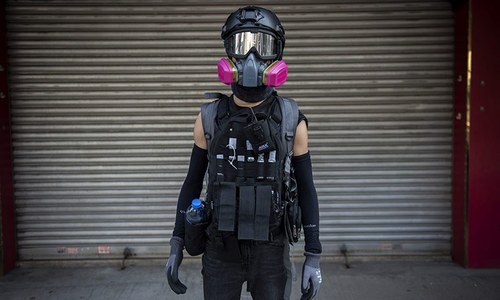
The ban on face-covering came into force in October, when the city's unelected pro-Beijing leader invoked colonial-era legislation for the first time in more than 50 years.
The move was seen as a watershed legal moment for the city since its 1997 return by Britain to China — but has been largely symbolic.
The city's high court ruled on Monday that the government ban on face masks was unconstitutional. But Beijing said the judicial branch of the special administrative region had overreached.
Zang Tiewei, a spokesman of the National People's Congress, said only the legislature had the right to rule on whether a law is in accordance with the Basic Law — the city's mini-constitution.
“No other institution has the right to make judgements or decisions,” Zang said, according to a state media report posted on the NPC's website.
He said the ruling had “severely weakened the governance” of Hong Kong chief executive Carrie Lam and the city government. Zang also indicated that the legislature might take some form of action.
“We are considering the relevant opinions and suggestions put forward by some NPC deputies,” he said, without elaborating.
Protests started in June as a peaceful condemnation of a now-shelved China extradition bill, but have morphed into a battle to defend unique freedoms unseen on the mainland, which include freedom of speech and an independent judiciary.
Dennis Kwok, a pro-democracy lawmaker, warned that taking away the power of the courts in Hong Kong “will be the end of one country, two systems” — the policy that governs the city.
“This is not a time to burn down your own house or to destroy the rule of law in Hong Kong,” Kwok said.
“Respect the courts in Hong Kong, respect our system and this is the essence of the one country two systems.”
On Twitter, democracy activist Joshua Wong saw the NPC statement as a warning that it would reinterpret Hong Kong's constitution. “When the state loses, she changes the rules of game. Beijing never intends to play by the rules,” Wong said.
'Hong Kong's thugs'
China has repeatedly warned that it would not allow the city to spiral into total chaos, fuelling concerns that Beijing might deploy troops to quell the unrest.
China's ambassador to Britain, Liu Xiaoming, warned on Monday that the central government would not sit idly by if the situation got out of control. “We have enough resolution and power to end the unrest,” Liu said.
Beijing has so far backed Lam and the city's police force.
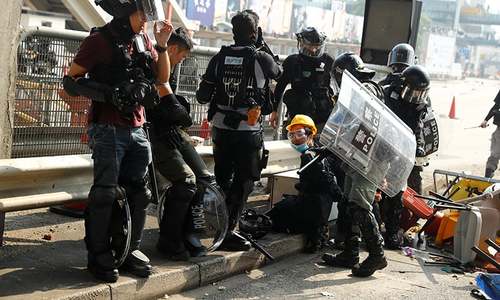
This week police laid siege at a university campus where protesters — some armed with bows and homemade catapults to fire bricks — were holed up.
Dozens of exhausted pro-democracy protesters barricaded inside the Hong Kong Polytechnic University (PolyU) defied warnings to surrender on Tuesday after some escaped overnight by slithering down ropes from a footbridge.
Chinese state media slammed the high court ruling. “This disappointing verdict will encourage radical protesters to do evil and discourage the police from curbing violence,” the nationalist Global Times said in an editorial.
In a strident front-page commentary, the People's Daily accused Western politicians of defending “violent crimes” and “anti-China forces” in Hong Kong.
“Violent crime is not only a 'virus' that endangers Hong Kong society, but also a public enemy that endangers all mankind,” the Communist Party mouthpiece said.
“The atrocities of Hong Kong's thugs have gone beyond the bottom line of human morality and civilisation, and will not be allowed in any country or civilised society,” it said.