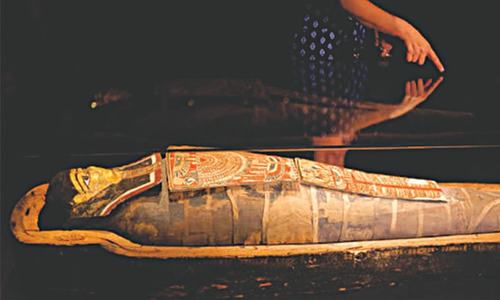
LUXOR: Egypt on Saturday unveiled the details of 30 ancient wooden coffins with mummies inside discovered in the southern city of Luxor in the biggest find of its kind in more than a century.
A team of Egyptian archaeologists discovered a “distinctive group of 30 coloured wooden coffins for men, women and children” in a cache at Al Asasif cemetery on Luxor’s west bank, the Ministry of Antiquities said in a statement on Saturday.
“It is the first large human coffin cache ever discovered since the end of the 19th century,” the Egyptian Antiquities Minister Khaled El-Enany was quoted as saying during a ceremony in Luxor.
The intricately carved and painted coffins, three thousand years old, were closed with mummies inside and were in “a good condition of preservation, colours and complete inscriptions”, the statement added.
They were for male and female priests and children, said Mostafa Waziri, the excavation team leader, dating back to the 10th century BC under the rule of the 22nd Pharaonic dynasty.
Despite their age, black, green, red and yellow paintings of snakes, birds, lotus flowers and hieroglyphics that cover the coffins are still clearly visible.
A sealed coffin belonging to a young ancient Egyptian child was incomplete and unpainted.
“We only did remedial first-aid on these well-preserved coffins. They are considered to be in great condition because there were hardly any settlements” around the site, said local antiquities ministry restorer Saleh Abdel-Gelil.
The coffins will undergo restoration before being moved to a showroom at the Grand Egyptian Museum, due to open next year next to the Giza pyramids, the ministry said.
The discovery is the latest in a series of major finds of ancient relics that Egypt hopes will revive its tourism sector, which has been badly hit by political instability since the 2011 uprising that toppled Hosni Mubarak.
Several high-level officials, including President Abdel Fattah al-Sisi, have in recent weeks affirmed Egypt’s stability following rare, small-scale protests in September that drew a heavy-handed response from security forces.
“Now in Egypt we have more security so we have more foreign nationals. We have more than 250 [archaeological] missions. More work equals more discoveries,” said Antiquities Minister Khaled el-Enany on the sidelines of the press conference.
Egypt has sought to promote its archaeological heritage and finds in a bid to revive its vital tourism sector, which has suffered due to political insecurity and terror attacks.
Published in Dawn, October 20th, 2019