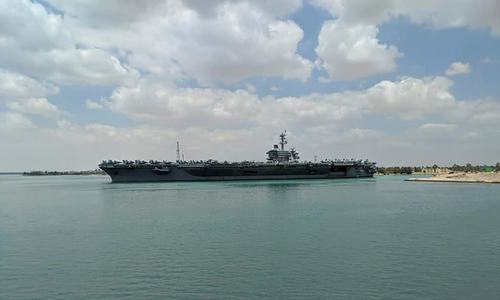
US sends naval strike group as tensions rise with Iran


The United States is deploying an amphibious assault ship and a Patriot missile battery to bolster an aircraft carrier and B-52 bombers already sent to the Gulf, ratcheting up pressure on Saturday on archfoe Iran.
In response to alleged threats from Iran, the USS Arlington, which transports marines, amphibious vehicles, conventional landing craft and rotary aircraft, and the Patriot air defence system will join the Abraham Lincoln carrier group, the Pentagon had announced on Friday.
The carrier and a B-52 bomber task force were ordered towards the Gulf, as Washington reiterated that intelligence reports suggested Iran was planning some sort of attack in the region.
Read: The US keeps turning up the pressure on Iran. But to what end?
United States Central Command (Centcom), the US forces for the Middle East and Afghanistan, said in a tweet on Friday that the B-52 bombers arrived at the area of operations on May 8, without saying where they had landed.
US President Donald Trump's national security adviser John Bolton has said the deployment aimed to send a “clear and unmistakable” message to Iran about any attack against the US or its partners in the region.
Washington has not elaborated on the alleged threat, drawing criticism that it is overreacting and unnecessarily driving up tensions in the region.
There was no immediate reaction from Tehran on the latest US moves, but earlier in the week it shrugged off the carrier deployment.
“Bolton's statement is a clumsy use of an out-of-date event for psychological warfare,” Iran's Supreme National Security Council spokesman Keyvan Khosravi said.
The increasing tensions come as Tehran said on Wednesday it had stopped respecting limits on its nuclear activities agreed under a 2015 deal with major powers.
Iran said it was responding to the sweeping unilateral sanctions that Washington has re-imposed since it quit the agreement one year ago, which have dealt a severe blow to the Iranian economy.
US 'not seeking war'
The Pentagon, for its part, said the deployments were “in response to indications of heightened Iranian readiness to conduct offensive operations against US forces and our interests”.
“The Department of Defence continues to closely monitor the activities of the Iranian regime, their military and proxies,” it said.
“The United States does not seek conflict with Iran, but we are postured and ready to defend US forces and interests in the region.”
Amid the rising tensions, Trump said on Thursday he was open to talks with Tehran's leadership.
“What I would like to see with Iran, I would like to see them call me,” Trump told reporters at the White House. “We don't want them to have nuclear weapons — not much to ask,” he said.
In the latest of a series of escalating statements, however, Secretary of State Mike Pompeo the same day threatened a “swift and decisive” US response to any attack by Iran.
“Our restraint to this point should not be mistaken by Iran for a lack of resolve,” he said, adding however: “We do not seek war.”
In May last year, Trump pulled the US out of an agreement aimed at curtailing Iran's nuclear ambitions and reinstated unilateral economic sanctions.
On Wednesday, President Hassan Rouhani said Iran would no longer implement parts of the deal and threatened to go further if the remaining members of the pact, including the European Union, failed to deliver sanctions relief to counterbalance Trump's renewed assault on the Iranian economy within 60 days.