• Two camps in cabinet take strong positions for and against the scheme
• PM decides not to approve a major initiative of his government in a hurry
• Finance minister says the plan will be presented in next cabinet meeting on April 23
ISLAMABAD: The Pakistan Tehreek-i-Insaf government’s first proposed tax amnesty scheme appears to be going into the cold storage after two camps in the federal cabinet have taken strong positions for and against it.
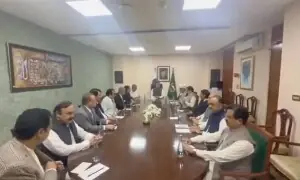
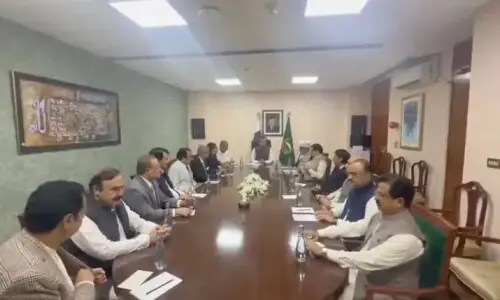
The federal cabinet, which met for the second consecutive day on Wednesday on a single point agenda, once again deferred its decision on the scheme until next week after the cabinet members took three to four long hours to argue their positions.
Prime Minister Imran Khan, therefore, decided not to approve a major initiative of his government in a hurry and give more time to the cabinet members to narrow down their positions on the contours of the scheme.
Finance Minister Asad Umar told Dawn after the special cabinet meeting that his fellow cabinet members took serious interest in the scheme and came up with valuable feedback. He said one camp argued that the scheme should be very liberal in terms of documentation and tax rates so that maximum people could avail it. This camp wanted easy documentation to facilitate maximum people, he added.
The other camp, according to the minister, took an opposite position and called for a scheme with stringent conditions, especially comparing with the previous government’s last tax amnesty scheme which was very liberal. This camp suggests launching of a crackdown on the people who have not declared their assets.
The finance minister said the prime minister had heard both sides and asked them to further fine-tune their positions. “We have discussed multiple versions of the scheme,” he said, adding that now further internal discussion would be held over the weekend on the proposals presented during the cabinet meeting.
The broader division between the camps, according to the finance minister, is over rates, repatriation of foreign assets and the extent of liberalisation of the scheme. “We have not decided any specific rate or made any decision so far.”
Mr Umar said the scheme had been deferred to make it acceptable to the whole cabinet, adding that the PTI government was not in a hurry and wanted to launch a quality scheme with wider acceptance. He also rejected a perception that the scheme would be meant for revenue generation. “We want to bring maximum untaxed wealth into the tax net,” he explained.
He said the scheme would be presented in the next cabinet meeting on April 23.
The government has already convened a new session of the National Assembly on April 22. This session had earlier been called on April 12, but a day before the government suddenly cancelled it and announced the new date, promoting a strong protest by opposition parties.
The opposition parties, led by the Pakistan Muslim League-Nawaz and Pakistan Peoples Party, accused the government of delaying the NA session only because it wanted to launch the amnesty scheme through a presidential ordinance.
It is unclear whether the government will once again delay the session or bring the scheme through parliament.
The new tax amnesty scheme also coincides with a new global anti-tax evasion scheme that is operational under a multilateral tax convention on the avoidance of double taxation and recommendations of the Financial Action Task Force (FATF).
The finance minister said that as part of the requirement, the government had already shared a draft of the tax amnesty scheme with the FATF and the International Monetary Fund. He said the scheme was being designed in a fashion to document the economy. “We have several representations from all quarters, asking for one-time relaxation for those who have not declared their assets.”
The new scheme has four main pillars — slabs, coverage of assets, exemption and filing of tax returns. The proposed slabs were five per cent, 7.5pc and 10pc for whitening the assets, though they could be changed before cabinet’s approval, a source said.
Moreover, the rates will also vary in cases of repatriation of assets to Pakistan and in cases of non-repatriation of foreign assets. However, it is not yet clear if the government will link the scheme with the repatriation of wealth.
Earlier in the day, Information Minister Fawad Chaudhry tweeted deferment of the assets declaration scheme because some of its provisions require “further fine-tuning”. He said the cabinet deliberated on all aspects of the proposed Assets Declaration and Amnesty Scheme, 2019, and that all options “came under threadbare discussion”.
But another cabinet member on condition of anonymity told Dawn that there was also another camp in the cabinet which had opposed the need for any kind of tax amnesty scheme for the whitening of black money. He said the PTI government had always opposed such schemes while in opposition and now wanted to follow the past practice.
He said that instead of announcing the tax amnesty scheme, the government should persuade people to come under the tax net. “We have sufficient data now from OECD countries as well as internal sources to bring tax evaders into the tax net,” the source said.
This move coincides with the implementation of the Benami Act in March 2019 in line with government’s efforts to document the economy — allowing tax officials to confiscate whole properties, expensive vehicles and bank accounts registered with fictitious individuals.
A senior tax official told Dawn that the tax amnesty scheme was being developed on the request of chambers and trade bodies, adding that the Federal Board Revenue was against tax whitening schemes, but the recent legislation like Benami Act needed to give one-time waiver to all people to declare their assets.
The official said businesses were facing problems in the wake of new legislations to declare their assets.
Published in Dawn, April 18th, 2019