State Bank of Pakistan receives $2.2 billion under Chinese loan arrangement



The State Bank of Pakistan (SBP) on Monday announced that it had received 15 billion Renminbi (RMB) — also known as yuan — equivalent to $2.2 billion, as proceeds for a loan extended to Pakistan by the Chinese government.
Finance ministry adviser and spokesperson Dr Khaqan Hassan Najeeb confirmed the development to DawnNewsTV.
Last week, the Ministry of Finance had announced that the SBP would receive a 15 billion yuan loan, equivalent to $2.1bn, from China by Monday (today).
Dr Najeeb had said that "all procedural formalities" for the transfer of the loan being provided to Pakistan by the Chinese government have been completed, and "the funds will be deposited in the SBP account by Monday, March 25".
The loan facility, the spokesperson had said, "will further strengthen foreign exchange reserves and ensure balance of payment stability."
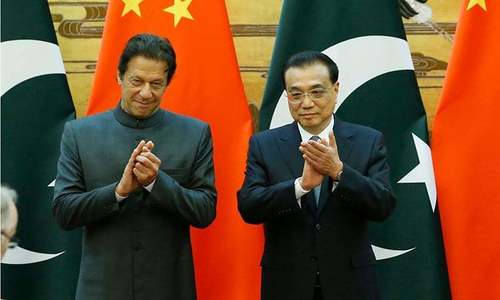
Following a meeting in Beijing between Chinese Premier Li Keqiang and Prime Minister Imran Khan in November 2018, China had said that it was willing to offer assistance to Pakistan to help it weather its current fiscal woes, but that the terms of such aid were still being discussed.
Shortly after, Chinese Consul General Long Dingbin had said during an interview that in order to "boost Pakistan's economy", Beijing is investing in multiple sectors and launching business ventures instead of providing loans.
In February this year, in response to a Financial Times report which said that China had pledged to lend at least $2bn to Pakistan to shore up its foreign exchange reserves and prevent further devaluation of the rupee against the dollar, Chinese foreign ministry spokesman Lu Kang had tentatively acknowledged that it was extending financial assistance to help Pakistan.
"The Chinese side has offered and will continue to offer its best through assistance, trade, investment and all-around practical cooperation to support and boost Pakistan’s economic and social development," Kang had said.
At the time, it was the first official confirmation by a Chinese official that Beijing had planned to extend a financial package to Islamabad. The terms of the package, however, had remained elusive until last week.
Additionally, Dr Najeeb today said that after receiving the Chinese loan, the foreign exchange reserves held by the SBP had hit the double-digit mark of $10.67bn.
In a tweet, he added that the net foreign exchange reserves held by commercial banks stood at $6.91bn.
He said the "implementation of a successful strategy" had resulted in the total foreign exchange reserves of the country rising to $17.58bn.