War is not a picnic, former Indian spy chief warns BJP-led govt

NEW DELHI: Former Indian spy chief A.S. Dulat said on Friday that war was not a picnic and asked Prime Minister Narendra Modi to weigh his widely speculated options against Pakistan with preference for an aggressive diplomacy.
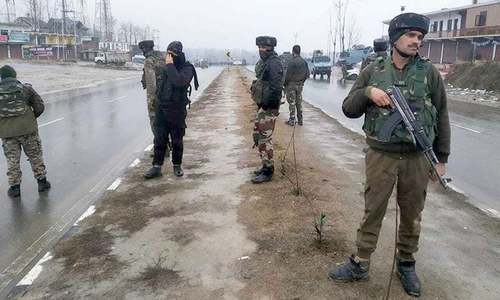
His views published by the Congress party-run National Herald newspaper tallied with former Congress home minister P. Chidambaram who said the suicide bomber who killed over 40 paramilitary men in Pulwama on Feb 14 was an Indian, and as such the government should focus on winning the hearts and minds of the alienated people of the disputed state.
Mr Dulat said he did not believe war was imminent.
“I don’t think so. The government [Prime Minister Modi] did say they were giving a free hand to the army, but wars are nastier these days. I’m sure there are other options short of war. Even after the Mumbai terror attack, there was a clamour for war, probably even louder, but Dr Manmohan Singh did not go to war. So, Modi has to weigh his options, people at the top have to weigh the consequences. War is not a picnic.
There hasn’t been a real war since 1971. Kargil was a limited operation and it was in the heights where fortunately not many civilians got affected. But, if Lahore is bombed, or Amritsar is bombed or even Muzaffarabad is bombed, are we prepared for the consequences? Today, the weaponry is also not that of 1971, it has all changed.”
In a separate interview elsewhere, Mr Chidambaram was asked the same question, he said: “I condemn the Pulwama incident. But the alleged perpetrator is an Indian, a Kashmiri. He is not a Pakistani.
He claims to have been influenced or indoctrinated by the Jaish-e-Mohammad, maybe that’s true. But if young men are pushed into the arms of militant organisations, whatever we do on the border, whatever we do to contain Pakistan, whatever we do to stop infiltration, whatever we do of cross-border action, is not going to yield any results."
"We have to win the hearts and minds of the people of Kashmir Valley,” said Mr Dulat, a Kashmir expert, who served as adviser to former prime minister Atal Bihari Vajpayee, adding that Mr Vajpayee had faced the worst of assaults – including the Kargil standoff, the parliament attack and the hijacking of the Indian airline plane to Kandahar. But he handled all the events with equanimity.
Mr Dulat, a Sikh, said the embrace between Congress minister in Punjab and former cricketer Navjot Sidhu and Pakistan’s Army Chief Qamar Javed Bajwa should not be misread.
“How Sidhu greeted General Bajwa is how Punjabis meet and greet each other. And here, they were not just Punjabis, but here was a Jatt Sikh from our side meeting a Jatt from the other side. The way a Sidhu and a Bajwa met is the normal way they would meet. If there was an element of embarrassment, it should have been caused more to Bajwa, who was in uniform. Sidhu did whatever he did spontaneously.”
Mr Dulat explained the genesis of the current spiral. “When you stop talking, then you are cutting down your options. That’s why we are back to the narrative of violence. When it comes to insurgencies worldwide, very rarely has an insurgency been sorted out or solved through force and by the gun.
The British, who dealt with this more than anybody else, had a huge problem in 1950 in Malaya. And that is when two of their top officers (a Field Marshal and a General) wrote the first handbook on how to deal with insurgency and the crux of that handbook, which is still used in the West, is that there is a need to win the hearts and minds of the people.”
Published in Dawn, February 23rd, 2019