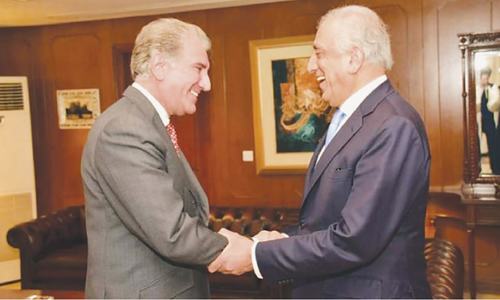
PM reiterates Pakistan's 'abiding interest' for Afghan peace in meeting with US envoy Khalilzad


Prime Minister Imran Khan on Wednesday reiterated Pakistan's "abiding interest" in achieving lasting peace and reconciliation in war-torn Afghanistan through a political settlement.
The premier gave the reassurance during a meeting a with the US Special Envoy for Afghan reconciliation Zalmay Khalilzad, who called on Khan at the Prime Minister House.
Khalilzad conveyed good wishes by President Donald Trump to Khan, saying the "US leadership looked forward to working with Pakistan in furthering the shared goal of peace through a political settlement in Afghanistan", according to a statement issued by the Prime Minister's Office.
During the "courtesy call" by the US envoy, Prime Minister Khan recalled his personal commitment to the cause of regional peace, the press release said.
He welcomed the letter written to him by President Trump seeking Pakistan's cooperation in ending the 17-year-old Afghan conflict, as well as Washington's "assurance to work with Pakistan on this shared objective".
Khan also emphasised the importance of boosting regular bilateral engagement in priority areas especially trade, investment, education, health and social sector development, the statement said.
Ambassador Khalilzad is on his third visit to Pakistan since he took charge of the office dealing with peace and reconciliation in Afghanistan in September. He accompanied Secretary of State Mike Pompeo to Islamabad just a day after his appointment and later visited the country again in October. His planned visit in November was cancelled because of scheduling issues.
Despite reservations over his appointment, Pakistan extended full support to him because of its principled position about supporting efforts for peace in Afghanistan and secondly to capitalise on the shift in the Trump administration’s policy towards negotiations with the Taliban.
In a major gesture to Washington in October after Khalilzad’s visit, Pakistan had set free former Taliban deputy chief Mullah Baradar. Foreign Office spokesman Dr Mohammad Faisal had on that occasion said that Baradar was released “at the US request in order to move forward on the shared objective of pursuing a political settlement in Afghanistan”.
There was, however, a brief hiccup afterwards due to Trump’s interview and a twitter exchange with Prime Minister Khan in which the US president questioned Pakistan’s contributions in the fight against terrorism, saying it did not “do anything for us, they don’t do a damn thing for us”.
However, in an effort to salvage the situation, Khalilzad’s Islamabad trip was preceded by a letter from President Trump to Prime Minister Khan in which he sought Pakistan’s help for the peace process and at the same time acknowledged that Pakistan suffered from terrorism. The letter managed to set a positive tone for the special envoy’s visit.
Khalilzad had on Monday met with Foreign Minister Shah Mehmood Qureshi and held delegation-level talks with Foreign Secretary Tehmina Janjua on the Afghanistan issue.
“Pakistan will continue to cooperate with sincerity for political settlement in Afghanistan. Long-lasting peace in Afghanistan is in Pakistan’s best interest,” Qureshi had tweeted after his meeting with the US envoy.
Khalilzad had in an interview before he embarked on his latest trip to the region said that he had been reassuring Pakistani leaders that the US was “not seeking an Afghanistan as the result of a political settlement that’s hostile to them”. He said that it was time for Pakistan to “play a positive role” for peace in Afghanistan.