Talks with the US


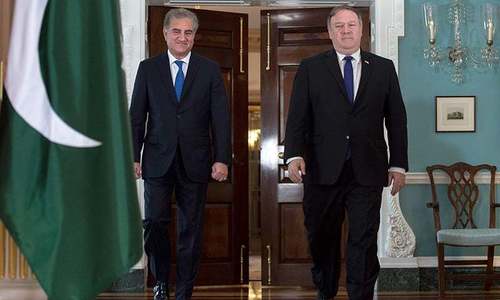
FOR the second time in less than a month, Foreign Minister Shah Mehmood Qureshi and his US counterpart, Secretary of State Mike Pompeo, have met to try and achieve a so-called reset in Pakistan-US ties.
It is not clear what progress was made during Mr Qureshi’s meetings in Washington D.C. — the foreign minister also met US National Security Adviser John Bolton — but the absence of a joint statement after the foreign minister-level talks suggests that there was no breakthrough.
Last month, following Secretary Pompeo’s hours-long stay in Pakistan, a so-called 2+2 meeting in New Delhi immediately after produced a harsh joint US-India statement against Pakistan.
Yet, the frequency of high-level meetings between the US and Pakistan is in itself an acknowledgement that the interests of the two countries, in this region and bilaterally, can only be furthered through dialogue and cooperation.
With the US continuing to insist that the bilateral relationship with Pakistan be seen primarily through the prism of Afghanistan, it is inevitable that much will depend on a second review of US policy in Afghanistan that President Donald Trump appears to want.
Oct 7 will mark the 17th anniversary of the beginning of the UN-sanctioned, US-led war in Afghanistan — the longest in American history. While Mr Trump has shaken up the post-Second World War global order and sowed a great deal of confusion among America’s traditional allies, at least on the issue of Afghanistan the president’s scepticism of the advice given by his generals and national security team is a potentially welcome disruption.
Opposed to fighting endless wars abroad and seemingly agnostic about what a peace settlement in Afghanistan may look like, Mr Trump’s apparent instincts align with what is known to be the only viable solution in Afghanistan: an Afghan dialogue process that creates political space for the Afghan Taliban and allows foreign troops to leave a relatively stable and peaceful Afghanistan.
Yet, like previous US administrations, the Trump administration has been unable to align its various interests in the region. While Afghanistan, Pakistan and the US are central to an eventual peace in Afghanistan, other regional and international powers — from Iran to India and from Russia to China — also matter.
But US policy towards those other countries has increased the complexity of the Afghan problem. From re-sanctioning Iran to getting closer to India, and from trade wars with China to sparring with Russia over election interference, the Trump administration may be unable to elicit the cooperation needed from those countries to achieve a stable Afghanistan.
If there is a point of convergence among all the regional, international and Afghan actors, it remains the militant Islamic State group and the need to prevent it from gaining a long-term presence in Afghanistan.
In recent years, Pakistan has consistently offered to do what it can to nudge along an Afghan dialogue and peace process. The US should seek to cooperate with rather than browbeat Pakistan.
Published in Dawn, October 4th , 2018