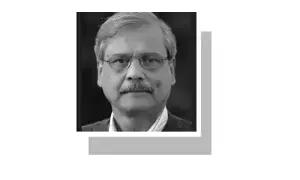
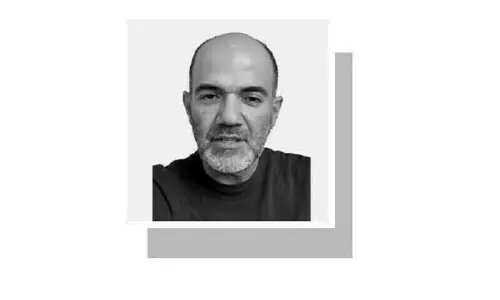
KARACHI: In moments of crisis, Pakistan and India have become more dependent rather than less dependent, on the outside world, said Dr Moeed Yusuf on Friday.
The associate vice president of the Asia Centre, United States Institute of Peace, gave a talk on the two nuclear powers in the auditorium of the Institute of Business Administration (IBA) here.
Pakistan and India, and the looming threat of nuclear war between the two, is a cautionary tale of how strategic neighbours with so much in common have become rivals always on the brink of a new crisis.
To deconstruct this relationship in the contemporary era, Dr Yusuf spoke about his latest book Brokering Peace in Nuclear Environments: U.S. Crisis Management in South Asia, in which he studied environments where nuclear weapons were present which changed the dynamics of any crisis. In it he proposed the theory of ‘brokering of peace’, and crisis management in the regional nuclear environment of Pakistan and India.
Citing examples from the nuclear tests of the two states, Kargil, the 2001-02 stand-off, Mumbai, as well as the so-called surgical strikes, Dr Yusuf explained that his research, while studying nuclear rivalries between Pakistan and India, led him to the realisation that there were powerful third parties, in this instance the United States, who were front and centre in the crisis management.
Previously, he explained, crises were studied as being bilateral engagements.
“Regional nuclear crises can no longer be studied as bilateral engagements and we must now be fundamentally studying third party mediations in environments where there are nuclear weapons,” he explained.
“My findings suggest that you will always have stronger third parties who want to influence the crisis because they are worried that things may escalate to the nuclear level. These third parties will show up on their own; for instance the US exaggerates the risk of nuclear escalation because of the lesson it drew from the Cold War which was that nuclear war, if it ever happens, will happen not because countries deliberately want it, but despite them not wanting it.”
“It is not that Pakistan and India want the third party,” he elaborated. “However, when the third party shows up to offer mediation and help mitigate the crisis, Pakistan and India recognise they do not have any dependable bilateral ties to bank on. Also, both states then tend to force the third party to deliver concessions rather than directly engage with the opponent. Both Pakistan and India try to use the third party, in this instance the US, to get concessions.”
This brokered bargaining, explained Dr Yusuf, required extensive scholarship so that crises should be viewed as trilateral engagements and not bilateral. “In this way we can assess and study the risks involved so that Pakistan and India know what to do in the future.”
Dr Yusuf also said that this model was not an effective way to resolve conflict; it merely helped to deescalate temporarily instead of solving the issue. As a result, future crises become harder to deter and may even become unmanageable.
“We have to internalise the role of the third party. The three-party crisis model is not what India and Pakistan should follow. This is a suboptimal model and not the way forward. This model is unlikely to be removed unless Pakistan and India get to a point in their relationship that they can communicate directly with each other in the time of a crisis.”
Former Defence Secretary retired Lt Gen Tariq Waseem Ghazi disagreed with this model.
According to him, there is a general disregard from India’s side to engage with Pakistan on a bilateral level as well as in the presence of a third party, whether it be the UN, the US or China.
“They say everybody else is irrelevant and wish to solely dictate the terms of engagement. In the last 10 years we have been trying to do exactly what Moeed has been proposing for crisis resolution and conflict prevention. But no proposal from us has been acceptable to India.”
Former Pakistan Nuclear Regulatory Authority chairman Jamshed Hashmi was of the opinion that the US tend to do more harm than good when trying to deescalate crises between Pakistan and India.
“The US will continue to ‘broker’ conflicts and we have to accept that. However, nowhere during this brokerage has the biggest point of contention between Pakistan and India — Kashmir — ever been debated on or the crisis resolved.”
Published in Dawn, September 15th, 2018