AS Imran Khan’s PTI starts work on government formation after its general election victory, parties on the losing side which are blaming their loss on rigging, may consider adopting a two-pronged approach as they move forward.
The first would obviously be to test the PTI leader’s offer of cooperation in investigating possible irregularities on election day in constituencies where they may have reason to believe the result did not represent the popular will on the day.
A deliberate distinction is being made here in the use of ‘on the day’ issues, as some in the media and Human Rights Commission of Pakistan have already raised concerns, while listing factors likely to have had an impact on the outcome of the elections ahead of polling day.
As the PTI found out most recently after the 2013 election, and before that the PPP in the 1990s, allegations of rigging are not easy to prove whether they are being made with or without justification.
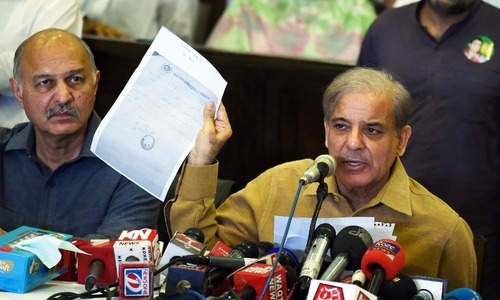
The insipid manner in which any advantage accruing to the PML-N was squandered by Shahbaz Sharif was reminiscent of the stuff political obituaries are made of.
Adopting this path takes resilience and painstaking effort as polling agents have to be deposed, legal challenges mounted, resources deployed for the recount and reverification of fingerprints on the ballot papers among a host of other similar tasks.
Perhaps the best way to move on this is that each party with a grievance or complaint about the conduct of the exercise on polling day should pick up a few constituencies where they believe the most outrageous of irregularities have taken place and seek a forensic audit.
This has to be done for two reasons: to establish the legitimacy of the allegations and equally to ensure that any loopholes in the process that can subvert popular will be plugged in future — on the day at least.
My thoughts are also being shaped by a sense that the current leadership of the major parties, which are attributing their loss to rigging and interference by quarters most of them are reluctant to name, lack the appetite for street agitation.
Perhaps this lack of appetite is informed by their experience that unless they have powerful backers among state institutions, coupled with committed and motivated cadres, it would be difficult to change anything via street protests.
Hence, the second prong of the strategy involves introspection. Multiple talking heads created a racket trying to speak over each other on TV rather than analyse the situation on results night. Ergo, it was difficult to make sense of what they were saying.
But even then the idiot box vigil was worth it. After all, the ‘analysts’ had drifted off the screens, possibly exhausted after rather competitive and prolonged stints on air, at some point, there appeared a pollster on one of the channels.
I am not trying to deny it credit, but I sincerely don’t remember the channel, not even the name of the pollster. Red-eyed and suffering from an overdose of ‘analyses’, I sat up as this man started to make a few points.
The first was that his organisation was correctly able to call the direction events would take on polling day as their surveys showed that the PTI’s consistent messages that Imran Khan took the lead in voicing resonated with many voters.
You and I may have found words such as ‘chor, daaku, patwari (thief, robber, land record official — the latter in rural areas is usually seen as corrupt) distasteful but somehow these were making a connection in Punjab in particular and nullifying Shahbaz Sharif’s development message.
He conceded that most of his surveys were carried out before the arrival and imprisonment of the PML-N leader and ousted prime minister Nawaz Sharif and Maryam Nawaz on July 13, a mere 12 days before the election.
Asked to explain the extraordinary support for the PTI in Khyber Pakhtunkhwa, he attributed it to the police reforms which had the most impact; as did some improvements in healthcare and education. Most of the blame for failures was deflected to an unfriendly centre.
Having heard the pollster, I reflected on the 2013 campaign and the election result. The two themes that the PML-N talked about endlessly in Punjab (and PTI in KP as elsewhere) were corruption and load-shedding.
These resonated with the electorate, decimating the PPP in Punjab and ANP-PPP in KP. Post Panama Papers, the PPP may have lacked the credibility to attack the PML-N in Punjab on ‘corruption’ but the PTI had no such handicap.
Had all other factors in the lead-up to the election been equal, even then I suspect that the PML-N would not have repeated its past performance at the polls simply because Shahbaz Sharif’s message was failing to gain traction on the ground and the PTI’s was.
The only effective counter to that was Nawaz Sharif-Maryam Nawaz ‘vote ko izzat do’ (honour the vote) campaign, with all its connotations, as it seemed to draw in and charge massive crowds at rallies before the father and daughter had to fly abroad.
And they had no control over the timing of the deterioration in Ms Kulsum Nawaz’s health, forcing them to extend their stay till their sentencing by the court. This meant they were not able to campaign during a critical period.
There was only one direction that the self-declared ‘sullah pasand (conciliatory)’ Shahbaz Sharif could have taken the PML-N and he did. Was he in denial that the forces he was trying to appease had already found a better horse to lay their final bet on as well?
The insipid manner in which any advantage accruing to the PML-N from the defiant duo’s return on July 13 was squandered by Shahbaz Sharif was reminiscent of the stuff political obituaries are made of.
As the governing party now will have to bear the bulk of the burden of scrutiny, away from the limelight opposition could do well to reflect on factors other than ‘rigging’ that may also have affected its electoral performance.
Admittedly, Shahbaz was an able deputy to his elder brother and an effective Punjab administrator but could not morph into a leader. The PPP also needs to put its best foot forward in delivery and leadership to revive its fortunes outside Sindh and to remain relevant in its power base.
The writer is a former editor of Dawn.
Published in Dawn, July 28th, 2018