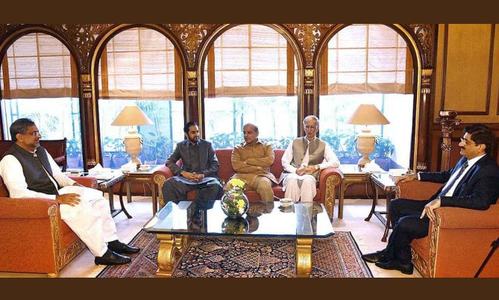
THE chaotic end of the National Economic Council meeting on Tuesday in some ways resonates with the overall disordered circumstances under which the budget is being drawn up.
With discord between the provinces — minus Punjab — and the federal government, the meeting, in which crucial allocations for the development budget were to be finalised for next year, ended with a walkout and an acrimonious blame game. However, the impasse is not likely to derail the finalisation of the allocations since provincial assent is not necessary for planning the development budget.
What is unusual this year is the amplitude of the chief ministers’ dissent with regard to the question of resource-sharing. According to reports emanating from the meeting, the objections began at the very outset. The chief ministers of three provinces — Sindh, KP and Balochistan (Punjab sent its finance minister who chose to stay) — walked out of the meeting after arguing for about an hour.
The disagreement revolved around resource commitment by the centre to projects in the provinces, in the interest of “balanced development and regional equity” as per Article 156(2) of the Constitution. The centre argued that this responsibility now belonged to the provinces after the 18th Amendment, and that federal development priorities were now focused on mainly national infrastructure.
The sudden nature of this dispute, which has not marred previous budget-making exercises in this way, suggests that the chief ministers showed up at the meeting with their minds already made up, and brought political motivations to an economic forum.
The leadership at the centre can cry foul but the chink in their own armour that was so effectively exploited by the chief ministers, and through which politics entered the conversation, is their own failure. The singular emblem of that failure is the inability to pass a National Finance Commission award during the PML-N’s five years in office.
Such matters ought to have been settled long ago at the NFC table but were not. As a result, matters moved along largely on the basis of an ad hoc understanding between all federating parties. This understanding was vulnerable all along to the gambit which the parties running the provincial governments — and that happen to be in the opposition in the National Assembly — were able to seize upon in the hour of the PML-N’s weakness.
The integrity of the budget process has taken a hit, but it will not be fatal. The allocations will still be decided by the cabinet as per its own wishes. But the repeated attacks on the government’s prerogative to decide allocations for the next dispensation, as well as the breakdown of consensus at the start of the budget process, will significantly weaken ownership and cloud economic policy for the entire year.
Published in Dawn, April 26th, 2018