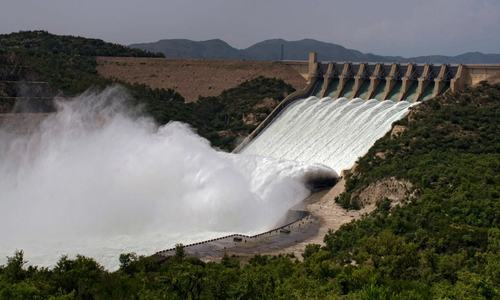
WASHINGTON: The World Bank confirmed on Thursday that it had received Pakistan’s complaint on the completion of the Kishanganga hydropower plant by India and was working with Islamabad and New Delhi for an amicable resolution of the dispute.
“We confirm receiving the letter from Pakistan earlier this week regarding the Indus Waters Treaty,” a spokesperson for the bank told Dawn in Washington. “The World Bank continues to work with both countries to resolve the most recent disagreement in an amicable manner and to safeguard the Treaty.”
Pakistan complained that India has violated a World Bank-mandated pause, placed in 2016, by completing the controversial Kishanganga project.
Pakistan believes that both Kishanganga (330 megawatts) and Ratle (850 megawatts) contravene the Indus Water Treaty’s restrictions on the construction of run-of-the-river plants. The plants are respectively on a tributary of the Jhelum and the Chenab rivers.
A World Bank fact-sheet notes that the two countries disagree over whether the technical design features of the two plants violate the treaty. The bank acknowledges that “the treaty designates these two rivers as well as the Indus as the Western Rivers’ to which Pakistan has unrestricted use”.
But in the same fact-sheet, the bank also says that “India is permitted to construct hydroelectric power facilities on these rivers subject to constraints specified in annexures to the Treaty”.
The annexures require that the design of any new run-of-river plant shall not raise the water level in the operating pool above the full pondage level specified in the design. It shall also take due account of the requirements of surcharge storage and of secondary power.
Published in Dawn, April 6th, 2018