WASHINGTON: Seventeen US intelligence agencies have warned Congress that Pakistan will continue to slip out of America’s influence and into China’s orbit in 2019, and will become a threat to Washington’s interests in the South Asian region.
The review is part of an annual report that Director of US National Intelligence Daniel R. Coats presented to the Senate Intelligence Committee on Tuesday, underlining worldwide threat assessment of the American intelligence community.
The 17 agencies that jointly produced this report include Central Intelligence Agency, Defence Intelligence Agency, Federal Bureau of Investigation and National Security Agency.
Pakistan
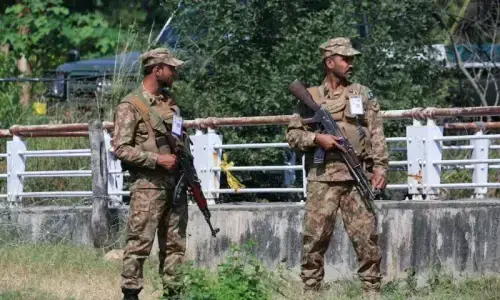
In their report on Pakistan, the agencies warned that the country will continue to threaten US interests by “deploying new nuclear weapons capabilities, maintaining its ties to militants, restricting counterterrorism cooperation, and drawing closer to China”.
The report claimed that Islamabad-backed militant groups will continue to take advantage of their alleged safe haven in Pakistan to “plan and conduct attacks in India and Afghanistan, including against US interests”.
The agencies also warned Pakistan’s perception of its “eroding position relative to India, reinforced by endemic economic weakness and domestic security issues, almost certainly will exacerbate long-held fears of isolation and drive Islamabad’s pursuit of actions that run counter to US goals for the region”.
In a brief assessment of Islamabad’s nuclear programme, US intelligence agencies informed Congress that Pakistan continues to produce nuclear weapons and develop new types, including short-range tactical weapons, sea-based cruise missiles, air-launched cruise missiles, and longer-range ballistic missiles.
“These new types of nuclear weapons will introduce new risks for escalation dynamics and security in the region,” the report added.
India-Pakistan Tension
US agencies also expect relations between India and Pakistan to remain tense, with continued violence on the Line of Control and “the risk of escalation if there is another high-profile terrorist attack in India or an uptick in violence on the Line of Control”.
India-China Tension
The agencies informed Congress that in 2019, relations between India and China will remain tense and will possibly deteriorate further, despite the negotiated settlement to their three-month border standoff in August.
This “elevates the risk of unintentional escalation”, the report added.
Afghanistan
The US intelligence community expects the overall situation in Afghanistan to “deteriorate modestly” this year in the face of persistent political instability, sustained attacks by the Taliban-led insurgency, unsteady Afghan National Security Forces (ANSF) performance, and chronic financial shortfalls.
The agencies warned that the National Unity government in Kabul “probably will struggle” to hold long-delayed parliamentary elections, currently scheduled for July 2018, and to prepare for a presidential election in 2019.
“The ANSF probably will maintain control of most major population centres with coalition force support, but the intensity and geographic scope of Taliban activities will put those centres under continued strain,” the agencies assessed.
The agencies believe that Afghanistan’s economic growth will stagnate at around 2.5 per cent per year, and Kabul will remain reliant on international donors for the great majority of its funding well beyond 2018.
Russia
US intelligence agencies see Russia as bringing pressure on Central Asia’s leaders to reduce engagement with Washington and support Russian-led economic and security initiatives, and believe that “concerns about [the militant Islamic State group] in Afghanistan will push Moscow to strengthen its security posture in the region”.
Published in Dawn, February 15th, 2018