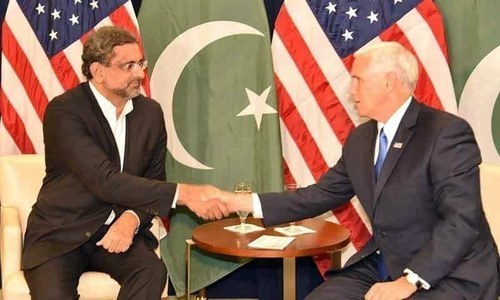
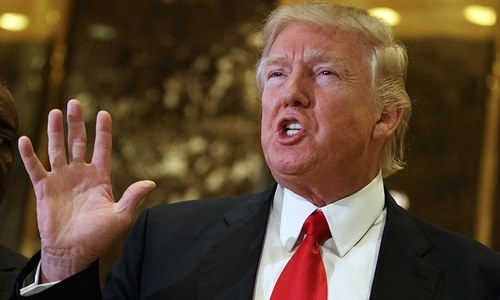
Foreign Minister Khawaja Asif on Friday claimed that Pakistan does not have an alliance with the United States (US).
“We do not have any alliance," Asif said during an interview with the Wall Street Journal. "This is not how allies behave," he added, referring to US President Donald Trump's administration's decision to suspend its entire security assistance to Pakistan.
The suspension of security assistance for Pakistan ─ announced last week ─ comes as the Trump administration seeks more cooperation from Islamabad as part of its strategy in Afghanistan.
State Department Spokesperson Heather Nauert said during the announcement that the suspension would remain in effect until Pakistan "takes decisive action" against groups such as the Taliban that are "destabilising the region and targeting US personnel".
Read more: Faltering Pak-US ties
During his interview with the Journal, Foreign Minister Asif said that Pakistan had made a "huge mistake" when it agreed to join America's campaign in Afghanistan in 2001, in the wake of the 9/11 terror attack.
He added that the move had engendered a terrorist backlash against Pakistan.
Asif maintained that Washington has turned Islamabad into a "whipping boy" for its failures in Afghanistan.
While speaking about the successes of Pakistan's recently launched counter-terrorism operations, Asif said that Islamabad would not allow the Afghan war to be fought on Pakistan's soil.
“We have relative calm in Pakistan at the moment,” Asif said. “But if we go against these people [Afghan insurgents], then the war will again be fought on our soil, which will suit the Americans.”
In the new year, Washington has increased pressure on Islamabad to "do more" in the fight against terrorism.
Washington has stated that the suspension of military aid, which came after Trump accused Pakistan of "lies and deceit", is part of America's South Asia strategy.
The development has followed in the aftermath of an increasingly terse back-and-forth between Washington and Islamabad since Trump announced the policy.
In Pakistan, the move has been seen as the first step to implementing Trump’s pledge to tighten economic restrictions on Islamabad.
Despite the tension, however, US and Pakistani officials remain in contact with each other. US Defence Secretary James Mattis on Friday said that the Pentagon was maintaining its communication with the Pakistani military establishment even after the suspension of military assistance.
Foreign Secretary Tehmina Janjua has said that Pakistan will continue to engage with Washington as far as possible, because America is not only a global power but also has a regional presence, and "for us it’s almost our neighbour".