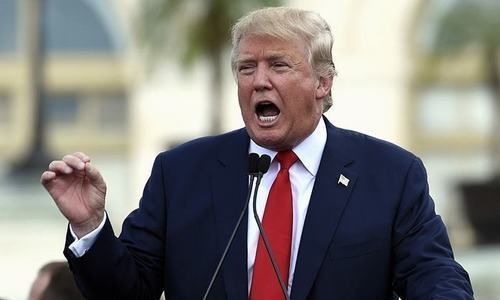
President Donald Trump boasted that he has a bigger and more powerful “nuclear button” than North Korean leader Kim Jong Un does — but the president doesn’t actually have a physical button.
The president’s Tuesday evening tweet came in response to Kim’s New Year’s address, in which he repeated fiery nuclear threats against the United States. Kim said he has a “nuclear button” on his office desk and warned that “the whole territory of the US is within the range of our nuclear strike.”
Trump mocked that assertion, writing, “Will someone from his depleted and food starved regime please inform him that I too have a Nuclear Button, but it is a much bigger & more powerful one than his, and my Button works!”
But despite ratcheting up the tension, Trump doesn’t really have a nuclear button.
The process for launching a nuclear strike is secret and complex and involves the use of a nuclear “football”, which is carried by a rotating group of military officers everywhere the president goes and is equipped with communication tools and a book with prepared war plans.
If the president were to order a strike, he would identify himself to military officials at the Pentagon with codes unique to him. Those codes are recorded on a card known as the “biscuit” that is carried by the president at all times. He would then transmit the launch order to the Pentagon and Strategic Command.
Earlier on Tuesday, Trump sounded open to the possibility of an inter-Korean dialogue after Kim made a rare overture toward South Korea in a New Year’s address. But Trump’s ambassador to the United Nations insisted talks would not be meaningful unless the North was getting rid of its nuclear weapons.
In a morning tweet, Trump said the US-led campaign of sanctions and other pressure were beginning to have a “big impact” on North Korea. He referred to the recent, dramatic escape of at least two North Korean soldiers across the heavily militarized border into South Korea. He also alluded to Kim’s comments on Monday that he was willing to send a delegation to the Winter Olympics, which will be hosted by South Korea next month.
“Soldiers are dangerously fleeing to South Korea. Rocket man now wants to talk to South Korea for first time. Perhaps that is good news, perhaps not - we will see!” Trump said, using his derisive moniker for the young North Korean leader.
South and North to meet?
In response to Kim’s overture, South Korea on Tuesday offered high-level talks on Jan 9 at the shared border village of Panmunjom to discuss Olympic cooperation and how to improve overall ties. The South said on Wednesday that North Korea’s state-run radio station announced the North would reopen a cross-border communication channel.
If there are talks, they would be the first formal dialogue between the Koreas since December 2015. Relations have plunged as the North has accelerated its nuclear and ballistic missile development that now poses a direct threat to America, South Korea’s crucial ally.
The US administration, however, voiced suspicions that Kim was seeking to drive a wedge between Seoul and Washington. Pyongyang could view a closer relationship with Seoul as a way for reducing its growing international isolation and relief from sanctions that are starting to bite the North’s meager economy.
“We won’t take any of the talks seriously if they don’t do something to ban all nuclear weapons in North Korea,” US Ambassador Nikki Haley told reporters at the United Nations. “We consider this to be a very reckless regime. We don’t think we need a Band-Aid, and we don’t think we need to smile and take a picture.”
North Korea has been punished with unprecedented sanctions at the UN over its weapons programs, and Haley warned on Tuesday of more measures if the North conducts another missile test.
South Korea’s liberal President Moon Jae-in has supported Trump’s pressure campaign against North Korea, but he’s less confrontational than the US president and favors dialogue to ease the North’s nuclear threats. Moon has long said he sees the Pyeongchang Olympics as a chance to improve inter-Korean ties.
White House spokeswoman Sarah Huckabee Sanders said that the US would continue to put “maximum pressure” on North Korea to give up its nukes. South Korea shares that goal, she said.