ISLAMABAD: With a noticeable decline in terrorist activities within its borders, Pakistan was placed at fifth position in the Global Terrorism Index 2017 released on Wednesday.
The report on the index, released by the Australia-based Institute for Economics and Peace, said that in Pakistan the number of people killed in terrorist attacks fell to 956 last year, a reduction of 12 per cent as compared to the previous reporting year.
This was the lowest number of deaths recorded since 2006. Since 2007 the country has been ranked at least as the fourth worst country for terrorism and on six occasions was placed at the second position.
Terrorist activities declined also in Syria, Afghanistan and Nigeria which, along with Pakistan, were four of the five countries affected the most by terrorism, said the report.
The 10 countries most affected by terrorism in 2016 were Iraq, Afghanistan, Nigeria, Syria, Pakistan, Yemen, Somalia, India, Turkey and Libya.
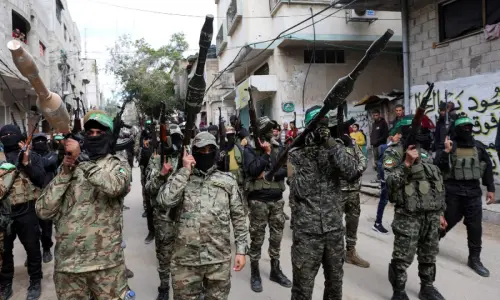
The decline in terrorist activities in Pakistan largely reflected the fact that during the period under review the Khorasan chapter of the militant Islamic State (IS) group and Tehreek-i-Taliban Pakistan (TTP) focused more on Afghanistan, according to the index.
The trend of reduced killings reflected the decline in activities of the TTP which has killed the most people in Pakistan.
Since 2000, the TTP has been responsible for at least 4,500 deaths, which account for over half of all deaths attributable to known militant groups.
The reduction in deaths in terrorist attacks is in part due to Operation Zarb-i-Azb that was launched by the Pakistan Army in mid-2014. The operation focussed on destroying militant safe havens in the North Waziristan Agency.
The military estimates that as a result of the operation over 3,500 TTP members were killed. It is also assumed that many more members fled to Afghanistan, which unfortunately bolstered the number of Taliban fighters in Afghanistan.
The TTP was responsible for 283 killings in 2016, which accounted for 30 per cent of the total deaths from terrorism that year. However, it should be noted that 30pc of all deaths are not claimed by any group.
Most of these deaths were caused by suicide attacks.
The largest bombing targeted Christians celebrating Easter Sunday at Gulshan-i-Iqbal Park in Lahore and killed 79 people. This was the deadliest attack in the country since the 2014 attack on the Army Public School in Peshawar which killed over 150 people, mostly students.
Other groups busy in terrorist activities included the Khorasan chapter of IS, which was responsible for 16pc of the deaths in Pakistan.
Lashkar-i-Jhangvi continued to operate and accounted for 11pc of the deaths last year. At least seven different Baloch nationalist groups undertook attacks in south-western parts of the country that resulted in 61 deaths in 60 separate attacks.
The report said that last year deaths resulting from terrorism decreased by 13pc to 25,673 in the world. Deaths have now fallen by 22pc from the peak in 2014.
There has also been an increase in the number of countries that improved their GTI scores: 79 countries improved their scores while in the case of 58 the scores decreased.
The decline in killings is encouraging, but 2016 was still the third deadliest year for terrorism since 2000 with a nearly eight-fold increase in the number of deaths over this time period.
Published in Dawn, November 16th, 2017