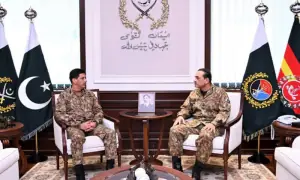
KABUL has once more relayed its intentions to postpone a review meeting of the Afghanistan Pakistan Transit Trade Coordination body, through a message saying it wants India to have a place at the table before proceeding. These postponements are routine, and have been going on for some years. Since last year, even the preliminary meetings have been halted for the same reason. What is of note this time round is that the postponement comes after a meeting between army chief Gen Qamar Bajwa and President Ashraf Ghani that had raised hopes of an improvement in Pak-Afghan ties. If there is a thaw under way, it is moving at a glacial pace. Given the positive chemistry on display during the meeting, it can be surmised that both countries are interested in moving forward, but that intention must quickly be backed up with actions on the ground. Talks on the Afghan transit trade provide the perfect opportunity for this, since they involve an enterprise that is good for both countries, although more beneficial for Afghanistan, and there is no baggage from the conflict that divides the two states.
The view from here is that Kabul’s repeated postponement of the talks is being done at the behest of India. The question of overland trade between India and Afghanistan is an important one, and Pakistan ought to do more to find ways to advance the proposal, but it is debatable whether this means that India ought to have a place at the table when transit trade is discussed. Such talks are bilateral in nature, and even though Pakistan has an interest in transiting its trade through Afghanistan to reach Tajikistan, it has never demanded that the latter have a place at the table during the talks. There may be some cheer in Kabul at the emergence of Chabahar as an alternative to Karachi, but freezing further talks with Pakistan because of this is a folly to be avoided. Not only are two ports better than one, but with the progress of CPEC, and the emergence of Gwadar, further opportunities are going to open to the east for Afghanistan. The government in Kabul should take a longer view of where it wants its external economic relations to be in the years to come.
Published in Dawn, October 13th, 2017