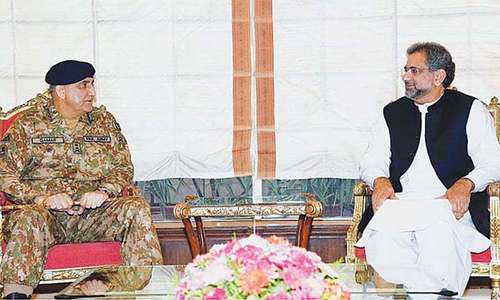
It was a political tour de force, a performance worthy of an information minister in a democratic regime.
Maj Gen Asif Ghafoor’s news conference at the ISPR headquarters on Thursday was remarkable for the ground that was covered — and, crucially, for what was left unsaid.
This much is obvious: the DG ISPR was not riffing, ad-libbing or speaking off the cuff; his remarks were carefully prepared and his answers hewed to a carefully prepared script. Maj Gen Ghafoor’s comments, then, almost certainly reflect the consensus view of the current military leadership on the range of national security, foreign policy, domestic politics and legislative issues that he expounded on. Which in and of itself has raised a profound question: why has the military leadership deemed it necessary to weigh in publicly on such a range of issues at this time?
There may be a temptation to view the intrusion into the civilian domain merely in the context of the current political crisis in the country. But a historical perspective would suggest that the intrusion is nothing new and indeed goes back to the very earliest years of the republic. Rare has been the occasion that the opposite was true.
The resignation of Gen Jahangir Karamat more than two decades ago had suggested that a clearer demarcation of the respective civilian and military domains may be possible, but that incident was soon overtaken by a second-term prime minister Nawaz Sharif’s tinkering with the military high command.
There is also the unfortunate reality that the civilians have at times willingly ceded space — willing to trade constitutional prerogatives for a bit of political longevity. Undoubtedly, the pressure at the very top is intense, but a true democratic leadership would fight harder for principle than self-interest.
For all of Maj Gen Ghafoor’s extensive comments and emphatic clarity, there was puzzling reticence on one matter. When asked why there had been no press release after a marathon corps commanders’ conference on Tuesday, the DG ISPR only offered that “Silence is also an expression”.
Whether by design or inadvertently, the comment set off a storm of political speculation. Is the military leadership suggesting disapproval of the PML-N government and its seeming quest to return Mr Sharif to a front-line role in politics despite judicial misgivings?
Indeed, the perceived significance of the news conference was precisely the intensive military deliberations at a time when Pakistan is facing great uncertainty in its relations with the US and the country has a political government that has effectively stalled.
A deliberate silence should not have been an option. Be that as it may, the PML-N government and the military leadership must independently and jointly recognise that the present level of uncertainty in the country is deeply undesirable and unsustainable. The Constitution is supreme and the Constitution is democratic — and all sides must re-emphasise their loyalty to it.
Published in Dawn, October 7th, 2017