An uncharacteristically stern response by the National Security Committee to US President Donald Trump’s so-called South Asia strategy is a worrying indication of the strategic chasm between Pakistan and the US.
With words and phrases such as “outrightly rejected”, “scapegoat”, “grave challenge”, “Afghan war cannot be fought in Pakistan” and “India cannot be a net provider of security” sprinkled across the statement, the NSC has conveyed its unhappiness, perhaps even alarm, at the Trump strategy.
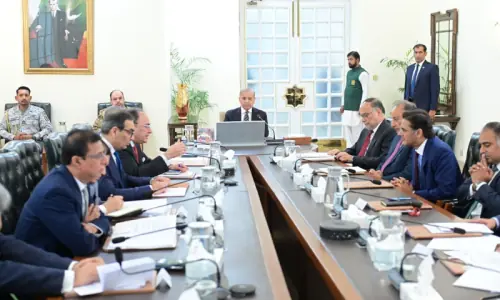
Nominally headed by the prime minister, the overwhelming military presence at yesterday’s meeting suggests that the statement is a true reflection of the national security apparatus’s grave concerns. Pakistan’s concerns over the Trump strategy are unsurprising; the strategy has almost universally been declared to be unrealistic and flawed.
From the NSC response, two key concerns of Pakistan can be gleaned. First, the Trump strategy appears to be an endorsement of perpetual war in Afghanistan, when it has long been clear that only “a politically negotiated outcome”, in the NSC’s words, can work.
Second, the so-called South Asia strategy puts the onus on Pakistan to act without offering to address any of this country’s regional security concerns. Specifically, the Trump administration’s silence on anti-Pakistan militant sanctuaries in eastern Afghanistan and its encouragement of India to play a greater role in Afghanistan amount to a puzzling disregard of Pakistan’s concerns. Why is Pakistan expected to act first to advance other powers’ interests and only then its own?
Merely labelling something a South Asia strategy does not automatically make it so. Indeed, it is Pakistan that appears to be seeking a true regional solution with its articulation of specific concerns, while the US approach amounts to something akin to a minus-Pakistan formula for peace. Because the US approach is wildly unrealistic, it is also dangerous.
Nevertheless, Pakistan must strive to avoid a strategic collision with the world’s only superpower. The US president’s obvious discomfort with a U-turn from his campaign pledge to extricate the US from Afghanistan presents an opportunity. A true regional approach to the Afghan question necessarily includes Iran, China and Russia, countries that Mr Trump all but ignored in his strategy.
For Pakistan, the challenge will be to pull together the diplomatic heft of those countries to cobble together a reasonable alternative to America’s latest approach. Regional ought to mean regional — a path to peace that allows Afghanistan peace and stability and balances the interests of outside powers in the immediate vicinity.
Surely, helping develop a regional consensus and encouraging the US to reconsider its own flawed approach is a better alternative than the dismal possibility of endless war in Afghanistan and the severing of even a transactional relationship between Pakistan and the US.
Published in Dawn, August 25th, 2017