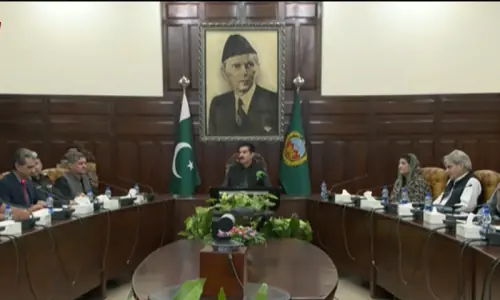
Leader of the Opposition in the National Assembly (NA) Khursheed Shah on Tuesday demanded Prime Minister Nawaz Sharif appear in the Lower House to brief lawmakers on the Saudi military alliance in the wake of a deepening diplomatic rift in the Middle East.
Shah, who claimed that Pakistan's foreign policy is failing, said the alliance formed to reduce terrorism had allegedly led to an increase in terrorism.
Bans against Qatar have resulted from the formation of the 41-nation military alliance, Shah alleged, adding that the government was, in reality, too afraid to take decisive action on the issue.
He pointed out that the government had encouraged the Opposition to present the resolution on Qatar although it had presented an earlier resolution on Iran on its own. According to Shah, the resolution on Qatar was presented at the behest of a Qatari royal.
The senior PPP leader claimed that despite Defence Minister Khawaja Asif's assurances to the house that a No-Objection Certificate (NOC) would not be issued to retired army chief, Gen Raheel Sharif without reaching an agreement on the terms of the alliance, an NOC was issued the very next day.
He refused to accept a briefing by the Adviser to the PM on Foreign Affairs Sartaj Aziz, demanding the premier's appearance in the house. He assured the ruling party that the Opposition would remain disciplined during Sharif's briefing to the House ─ should he choose to be present ─ and even offered to resign in opposition lawmakers failed to maintain order.
He requested the speaker to ensure the PM appears in the NA to brief the House on the Qatar crisis tomorrow.
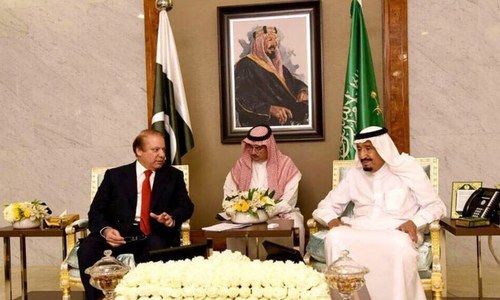
Prime Minister Nawaz Sharif is currently on a visit to Saudi Arabia where he has met with Saudi King Salman bin Abdul Aziz to discuss the deepening diplomatic rift in the Middle East.
Last week, Saudi Arabia, Egypt, the United Arab Emirates (UAE), Bahrain, Yemen and the Maldives severed their ties with Qatar, accusing it of supporting terrorism in an unprecedented rift between the most powerful members of the GCC.
In its response to the Middle Eastern crisis, Pakistan had stressed the need for unity in the Muslim world and urged the countries involved to engage in dialogue.
Last week, lawmakers at the National Assembly expressed "deep concern" over the diplomatic rift and passed a resolution urging all countries to "show restraint and resolve their differences through dialogue".
Earlier, a six-member Qatari delegation had reportedly visited Islamabad last week to relay a message from the Qatari emir, asking Pakistan to play a positive role in resolving the diplomatic crisis engulfing the Middle East.
The Foreign Office had denied knowledge of any such visit and has also recently denied foreign media reports of 20,000 Pakistani troops being deployed in Qatar.