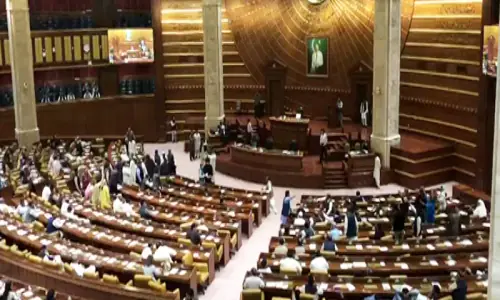
LAHORE: Something is incorrigibly wrong with the Punjab Assembly: it cannot get its timing and numbers right. On Friday, it started its proceedings 100 minutes late than the stipulated time of 9am and it took chief ministerial presence to ensure the presence of enough members to let the finance minister conclude the post-budget debate.
However, as soon as the minister for finance concluded her speech, the chief minister left the House (though not premises). Within next 15 minutes, the attendance dropped by almost 50pc and the proceedings survived the quorum scare only because the opposition had stakes in demands for grants that followed the speech.
Ayesha Ghaus Pasha was incisive and brief when she stood up to deliver her concluding speech. “The opposition has got most of its numbers wrong. It has alleged in the post-budget debate that the posterity would be held hostage to mounting debt. The factual situation is that total debt right now stands at Rs568 billion and 81pc is taken from the World Bank and the Asian Development Bank (ADB) for development schemes. It is a long-term debt (for 15 to 25 years) and at concessional (one per cent mark-up) rates. The total repayments (loan and interest) payments for the year 2017-18 would be Rs36 billion, or 2.5pc of the provincial GDP. If one separates mark-up payment, it is only one per cent of the GDP. In this situation, does the opposition charge of province collapsing under debt burden stick?
“Similar are the charges of reducing the education budget. The total allocation to the sector stands at Rs345 billion – Rs33 billion more than last year – but the opposition still charges the government with cutting the allocation. It also says Punjab is abdicating its responsibility on education by privatising government schools. The allegation is out of context. Punjab has only handed over management of “extremely poorly performing” institutions to some non-government organisations already working in the field.
“These schools and their finances are still government’s responsibility; only running of them has been delegated. As a result, enrolment has doubled as management efficiency tightens the affairs. Is the result good or bad?”
Appreciating the difficulty that the common man and some of the opposition members confront in deciphering voluminous budget documents and consolidating allocations under different heads, she announced releasing “citizens budget,” where all these things (income, expenditure and allocations) would be consolidated and simplified so that unnecessary misgivings are removed.
Justifying apparent reduction in allocations for agriculture, she said it was not at the expense of the farmers but because of structural adjustment. “This year, the federal government removed general sales tax (GST) on fertiliser, removing the need for subsidy. That is what created impression of cut in allocation. But, be clear that it was structural adjustment, not reduction.”
Reassuring the House, she said “your government is fiscally prudent and financially responsible. The current budget is the result of a long consultative process in which every stakeholder (all chambers, professional bodies, non-government organisation, common man) has been touched.
In pre-budget session, 72 members (26 from the opposition included) gave their suggestions.
On the second plank, the government has five-year growth strategy, which guides it in the development process. This finance bill is conflation of both and can yield only positive results.
The minister started her speech around 10.50am and the chief minister arrived in the House by 11am, giving boost to the presence of Treasury members. It was a rare occasion to see almost two dozen ministers occupying the front row. The Treasury had lost quorum on Thursday when the minister for finance was about to give her concluding remarks on budget, creating embarrassment for the government. In order to avoid the same awkward position, the chief minister graced the House that allowed the smooth sailing of the budget debate.
Published in Dawn, June 10th, 2017