Iran worries driving Arab states close to Israel, says Trump


 15
15

JERUSALEM: US President Donald Trump said on Monday that shared concern about Iran was driving Israel and many Arab states closer and demanded that Tehran immediately cease military and financial backing of “terrorists and militias”.
In stressing threats from Iran, Trump echoed a theme laid out during weekend meetings in Saudi Arabia with Muslim leaders from around the world, many wary of the Islamic Republic’s growing regional influence and financial muscle.
Trump, who spoke after arriving in Israel, has also vowed to do whatever is necessary to broker peace between Israel and the Palestinians. He focused firmly on Iran in talks with Israeli leaders in Jerusalem on the first day of his two-day trip, pledging he would never let Tehran acquire nuclear arms and saying the deal struck with Tehran by the Obama administration needed fixing.
“What’s happened with Iran has brought many of the parts of the Middle East toward Israel,” Trump said in public remarks at a meeting with Israeli President Reuven Rivlin.
In his comments to both Rivlin and Israeli Prime Minister Benjamin Netanyahu, Trump appeared to dwell on forging a regional coalition to counter what he described as Iran’s involvement in conflicts in the region, rather than renewed efforts to revive Israeli-Palestinian peace talks.
Israel shares the antipathy many Arab states have towards Iran, seeing the Islamic Republic as a threat to its existence.
Prays at Western Wall
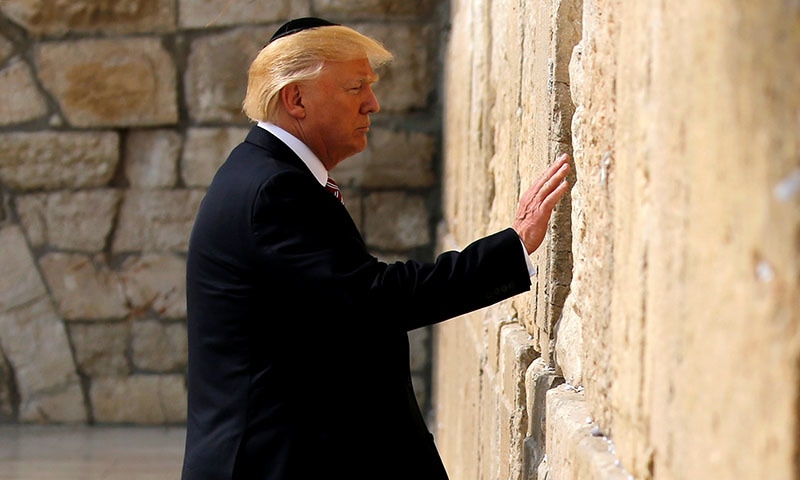
Later, he made a historic visit to Jerusalem’s Western Wall, standing before the holiest place where Jews are permitted to pray and saying a few words before inserting a note between the monumental stones.
He was accompanied by the Rabbi of the Western Wall, Shmuel Rabinowitz, who said on Israel Radio that he recited two psalms with the US leader. One of them, Psalm 122, speaks of Jerusalem as a “city that is united together”.
The ancient stones are in a part of Jerusalem that Israel captured in the 1967 Middle East war.The president was joined on the visit by his son-in-law, Jared Kushner, an Orthodox Jew who went to the wall shortly after Trump and said prayers. Both he and Trump wore black kippahs as a mark of respect.
It is the first time a sitting US president has visited and prayed at the site. Barack Obama visited in 2008, but it was during the campaign, before he became president.
As Trump and Kushner visited the area of the wall set aside for men, Melania Trump and Ivanka, Kushner’s wife, visited a separate nearby section where women are allowed to pray.
Published in Dawn, May 23rd, 2017