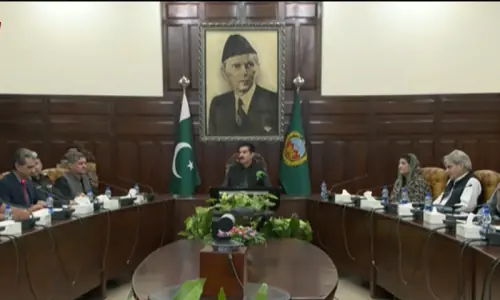
EVEN stating the obvious has value in the right circumstances. That is the case with army chief Gen Qamar Javed Bajwa’s remarks on Thursday at a seminar in Rawalpindi titled ‘Role of youth in rejecting extremism’, organised by the ISPR in collaboration with the Higher Education Commission.
The army chief said that the ultimate objective of all religions is to teach people how to lead a good life, not how to die a destructive death. And, he added, an individual’s social responsibilities extend only as far as to enjoin what is right and avoid what is forbidden. They do not give anyone the licence to impose their beliefs on others.
Ordinarily, it would be somewhat curious for an army chief to address a seminar on extremism. However, in Pakistan’s context, it is not only understandable but perhaps even necessary. After all, the military is on the front line of the extended fight against terrorism which in our case is the kinetic manifestation of religiously inspired extremism.
Moreover, it was an army chief, Gen Ziaul Haq, who, in pursuit of strategic regional objectives, patronised the ultra right and thereby set in motion a process of social engineering that has, over time, changed the very character of this nation.
The manipulation of religion for political ends — a policy which was continued after his death — also spawned violent extremist groups that have wreaked havoc in this country. This unfortunate reality makes the present army chief’s recent observations particularly significant, for they can be seen as a policy statement, a break from the past. That said, notwithstanding the symbiotic link between terrorism and extremism, the military’s limitations mean it is only equipped to deal with the former.
It is for the government, in fact the political class as a whole, to take up the gauntlet of countering extremism. And they must do so without resorting to petty point-scoring. Extremism is far too important an issue to be treated as a footnote and reduced to scattered, reactive statements.
Only a unified front with a clear, uncompromising and consistent message will be effective against what has become a pernicious threat to peaceful coexistence in this country. One way to demonstrate this is to condemn violence against members of any religious community, whether Christian, Hindu, Ahmadi, etc — even against those who profess to be secularists — and ensure that the perpetrators are successfully prosecuted.
There are laws against stoking hatred — from the pulpit or through the pages of school textbooks — and it is time they were implemented. The youth is particularly susceptible, and organisations with a militant bent should be stopped from recruiting students on university campuses. Turning our backs on decades of a ruinous policy and eradicating extremism from the grass roots will be an arduous process, but it can be done — if our elected representatives can rise to the challenge.
Published in Dawn, May 20th, 2017