8
8

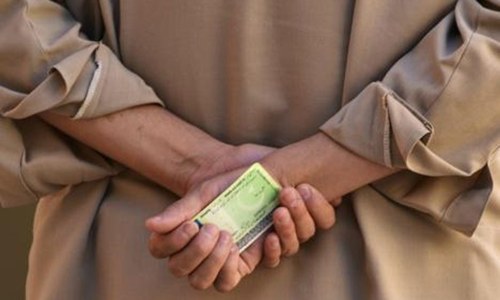
ISLAMABAD: With the controversy surrounding ethnic profiling in search operations raging across the country, the government disclosed in the Senate on Monday that over 300,000 CNICs had been blocked on suspicion, and almost a third of them belonged to foreign nationals.
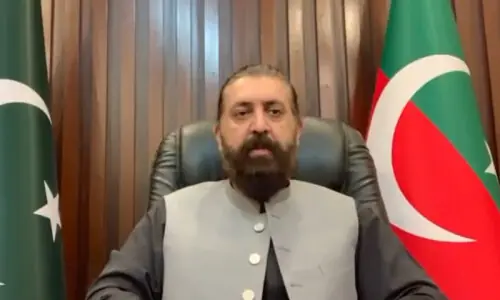
Sharing these figures for the first time in the Senate, Minister of State for Interior Baleeghur Rahman dispelled the impression that the number of blocked CNICs was in millions. The latest figure was 345,510, he said, adding that 175,000 of these were awaiting verification by intelligence agencies while over 52,000 CNICs were awaiting clearance by Nadra. He said 117,459 CNICs had been seized from foreign nationals.
Nadra has a huge volume of data on Afghan nationals who had applied for proof of registration (POR), Mr Rahman explained while pointing out that the CNICs had been blocked after the computer system identified the holders’ resemblance through facial recognition or thumbprint records. He said no one was allowed to block a person’s CNIC on their own whim.
Previously, joint verification committees would verify the credentials of people carrying dubious CNICs. However, this was a slow process, he said. In April last year, 88 zonal boards and eight regional boards were formed to handle the task instead, he said.
Minister tells Senate the letter allegedly written by Mandi Bahauddin DPO to police with instructions to single out Pakhtuns was fake
The parliamentary committee formed to suggest ways to expedite the verification process had met twice in two months, he said, adding that the committee, headed by the National Assembly deputy speaker, would meet on Wednesday. He hoped that the committee would devise a way forward in this regard.
Senate chairman Mian Raza Rabbani requested the minister to write a letter to security agencies conveying the Senate’s concerns over a delay in the verification exercise and the nuisance it has caused to a large number of people.
Mr Rahman contacted the Punjab government for their viewpoint on allegations of ethnic profiling and the contents of a letter written allegedly by the Mandi Bahauddin DPO to the police with instructions to single out Pakhtuns. The minister informed the House that the letter, which had gone viral on social media, was fake. Had the letter been genuine, it would not have been restricted to Mandi Bahauddin where the proportion of Pakhtun residents was lower than in many other cities of the province.
Similarly, a circular distributed among shopkeepers of Bilal Gunj in Lahore also had nothing to do with the Punjab government or the police.
Mr Rahman said a committee headed by Prime Minister Nawaz Sharif’s adviser, Amir Muqam, had met Chief Minister Shahbaz Sharif and conveyed the concerns of Pakhtuns. His suggestion of involving community elders in the raids was accepted at once, he said.
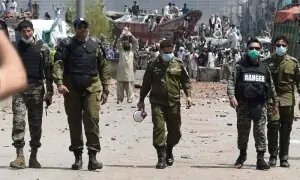
Over 200,000 people have been questioned in Punjab since the attacks began, he said, and 441 of them had been arrested. Of those, only 34 people were Pakhtun, he claimed.
The statistics were rejected by Senators Usman Kakar and Sardar Azam Musakhel who claimed that the number was higher in reality. The Senate chairman then asked them to provide their own statistics to challenge the ones provided by the minister.
The Senate also passed a resolution expressing concerns over the use of the term ‘Islamic terrorism’ by US President Donald Trump. The resolution was moved by former interior minister Rehman Malik.
The house, through another resolution, condemned the recent terrorist attacks on mosques in the US and in Canada and urged the respective governments to take steps to protect the religious freedom of Muslims. The house will meet again today (Tuesday) at 3pm.
Published in Dawn, March 7th, 2017