I first met Amjad Sabri during the month of Ramazan. The year was 2011. On a quiet Friday afternoon at FM 101 — a channel of Radio Pakistan where I then worked — I walked in to find one of the radio jockeys wrapping up her broadcast with Amjad.
I stopped in my tracks; here, in the flesh, was the man who had long mesmerised me by his powerhouse vocals.
The schedule didn't matter to me; I had to go up to him. “My show is next,” I said, introducing myself. “I would be honoured if I could discuss Qawwali, Sufism, and the artistic contributions of your gharana....”
In response to my expectant question, Sabri acquiesced. He had just come off air, but he didn't mind going right back on again.
Also read: ‘He had no enemies, who would kill Amjad Sabri?’
Inside the studio, our conversation moved quickly and deeply towards his one, singular passion: Qawwali.
Midway through the stimulating conversation, my mind wandered to the numerous times his expression of Sufi kalaam had utterly transfixed me.
I had to keep bringing myself back to the air-conditioned studio where we were sitting, and I couldn't help but feel humbled as I began to learn about the man behind the voice.
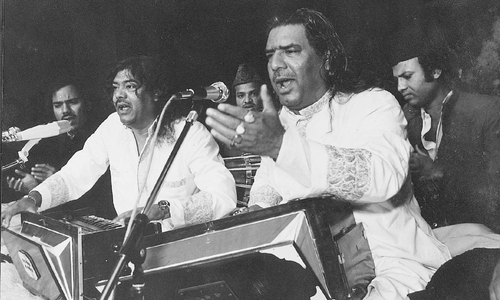
The Sabri brothers descend directly from one of the four original Qawwal gharanas, and Amjad took great pride in belonging to the celebrated Qawwal family — to a home where Qawwali was practiced day and night.
He talked about his early Qawwali training. His father Ghulam Farid Sabri and his uncle Maqbool Ahmed Sabri (the original Sabri brothers) were his mentors. At the age of nine, he was taken under their wing.
And from the beginning, Amjad never took Qawwali for granted; for him, it was much more than an inherited art from his family.
Qawwali was the vehicle that activated Amjad's soul
Even today, my first interaction with Amjad feels surreal. With each meeting subsequently, I learned to respect this simple man behind a towering legacy, who despite being diabetic, never let his own discomfort deter him from carrying on with his grueling routine.
He lived a life above worldly emotions, and did not consider his contemporaries as rivals. When singer Atif Aslam showed interest in singing the famous Qawwali 'Tajdar-e-Haram', which was originally sung by Amjad’s father, Amjad not only permitted it, but also praised Atif for delivering a powerful and befitting rendition.
Examine: Remembering Amjad Sabri: 5 of the legendary qawwal's most memorable performances
But his soulful rendition of ‘Karam maangta hoon, ataa maangta hoon’ is what moves me the most — this single hymn written in praise of God has extraordinary depth and artistry.
It was this rendition that prompted me to ask him how he managed to bring so much soul to his Qawwalis. His reply was short and absolute:
"It is merely my attempt at seeking forgiveness."
Today, as I sit grasping for words to explain the effect of a man over an entire generation, not just within Pakistan, I am reduced to asking what Mustafa Zaidi once did:
Main kis ke haath pe apna lahuu talaash karuun
Tamam shehr ne pehne huey hain dastaaney
On whose hands should I find my blood,
Everyone in this city is wearing gloves
Translated by Bilal Karim Mughal from the original in Urdu here.