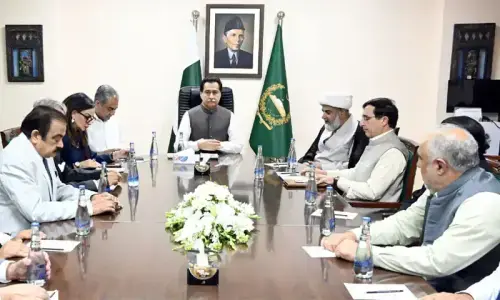
GUJRAT: The Centre for Languages and Translation Studies (CeLTS) of the University of Gujrat will translate all laws of the Punjab government from English into Urdu.
An agreement to the effect was signed between the UoG and Punjab law and parliamentary affairs department at a ceremony held at Hafiz Hayat Campus here on Wednesday.
UoG Vice Chancellor Prof Dr Ziaul Qayyum and Punjab Law Secretary Dr Syed Abul Hasan Najmi signed the agreement.
The ceremony titled ‘Translating laws – an important step towards promotion of Urdu,’ was attended as guests by prominent scholars and journalists from across the country.
They included Dr Qasim Bhogio, chairman of Literary Academy, Islamabad; media anchorpersons Sajjad Mir and Habib Akram, Dr Mohammad Latif, adviser research and development, Higher Education Commission, Khalid Mohammad Khan, commissioner Income Tax, Lahore, former ambassador Tauheed Ahmad and Director of Centre for Language Engineering, UET, Lahore, Dr Sarmad Husain.
“The decision of the Punjab government on making laws accessible to common man by translating them into Urdu is really commendable,” chief guest Prof. Dr Zia said.
“The UoG is fully aware of its social, intellectual and national responsibilities. We, at the university, have a clear and well-defined policy on the social role of academia. It is the extent of the role of universities in social development which decides the fate of a nation.
“The UoG is the only Pakistani university offering BS and MPhil in Translation Studies,” he said.
“Innovation, a prerequisite to progress, can be achieved only in one’s own language. Local languages have never been a hurdle in the way of Urdu,” Sajjad Mir said.
“Translation Studies is now treated as a proper discipline at the universities around the world. Laws play an important role in our life. They should be translated in a language easily understood by all,” Dr Qasim Bhogio said.
Dr Mohammad Latif said the HEC would provide UoG with every possible support in connection with the translation project.
Columnist Habib Akram said it was the need of the hour that all the judicial verdicts and laws should be translated in national language.
Dr Sarmad Husain said: “Translation is a difficult and creative job that demands meticulousness, adding that the project involves translation of about one million words from English into Urdu.”
Earlier, CeLTS head Dr Ghulam Ali threw light on various aspects of the project and said the translation would make laws accessible to commoners.
He told Dawn that some 15,000 documents would be translated in the first phase followed by the translation of provincial rules and regulations.
He said the translated version of the laws would be uploaded at the government’s website on a monthly basis as the first phase of the project would take at least 18 months.
Published in Dawn, April 28th, 2016