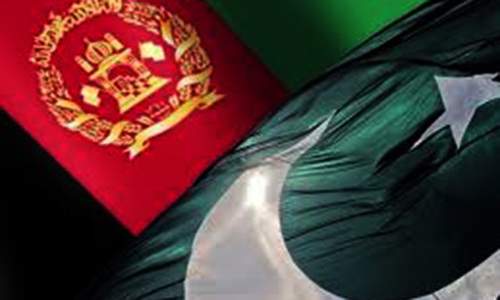
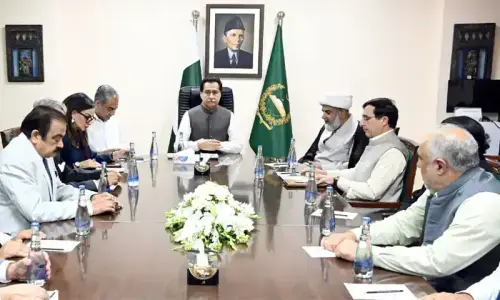
ISLAMABAD: The chief of Afghanistan’s spy agency met his Pakistani counterpart here on Thursday in what is being described as a first step towards bridging the trust gap between the two intelligence agencies and exploring the prospects of cooperation in fighting terrorism.
The meeting of the head of Afghanistan’s National Directorate of Security, Masoud Andrabi with Inter-Services Intelligence director general Lt Gen Rizwan Akhtar was the first high-level engagement between the two agencies since Afghan authorities succumbed to domestic political pressure and shelved ISI-NDS cooperation agreement weeks after it was signed in last May.
The meeting that continued for about two hours was facilitated by the US, while Chinese officials attended as observers.
There was no announcement about the meeting either from the Inter-Services Public Relations or ISI.
A source, who closely followed the meeting, said: “It was a step not a breakthrough.” He said the very fact that the meeting took place was a major development.
Tension between ISI and NDS is believed to be at the root of most of the problems in relations between the two neighbours which for most of the past decade and a half have been uneasy.
The intelligence dialogue has begun at a time when Pakistan, as part of a quadrilateral initiative, is trying to help revive the Afghan reconciliation process that was suspended after the disclosure about the death of Taliban leader Mullah Omar.
Afghan leaders have lately become conscious of Pakistan’s role in making the reconciliation effort successful. Afghanistan’s Chief Executive Abdullah Abdullah, who is visiting India, told journalists in Delhi that “Pakistan is the country which can do the most in terms of influencing the Taliban’s attitude. I think Pakistan has the most influence.”
And within Pakistan, Afghan leaders think ISI holds the key.
The immediate goal before the countries involved in the intelligence talks’ initiative is to formalise this engagement.
The source said that the first part of the meeting was very formal and stiff, but in the second part the two sides had some frank discussion about their concerns with the Pakistani side reiterating its allegations that Bacha Khan University attack last month was carried out by Afghanistan-based terrorist groups.
“ISI presented some evidence to the Afghan side pointing towards the involvement of TTP and some other terrorist groups who are operating from Afghanistan in sabotage activities in Pakistan,” an official said.
The source in particular praised the role played by China at the meeting, saying it was very positive.
MILITARY OPERATIONS DIRECTORATE: Afghan military operations chief Maj Gen Habib Hisari, meanwhile, held security and border management talks with his Pakistani counterpart Maj Gen Sahir Shamshad Mirza at the GHQ.
“Issues related to bilateral security and border management came under discussion. Both sides reiterated that terrorists operating on either side of the border will not be allowed to use their soil for any terrorist activity on either side of the border,” the ISPR said in a statement.
It further said that both sides resolved to continue the interaction for enhancing bilateral military-to-military coordination.
According to a source, reconciliation with the Taliban also came up for discussion during the meeting.
A meeting of the Quadrilateral Coordination Group on Afghan Reconciliation, which includes Pakistan, Afghanistan, the US and China, will be held on Feb 6 in Islamabad during which a roadmap for the process is likely to be adopted.
Gen Hisari’s visit is part of the military-to-military engagement process agreed during Army Chief Gen Raheel Sharif’s visit to Kabul in December last year.
The two sides have since then established a hotline between military operations chiefs. Pakistani DGMO Gen Mirza travelled to Kabul on Jan 13 and a bilateral Corps Commanders meeting was held in Peshawar last week.
Published in Dawn, February 5th, 2016