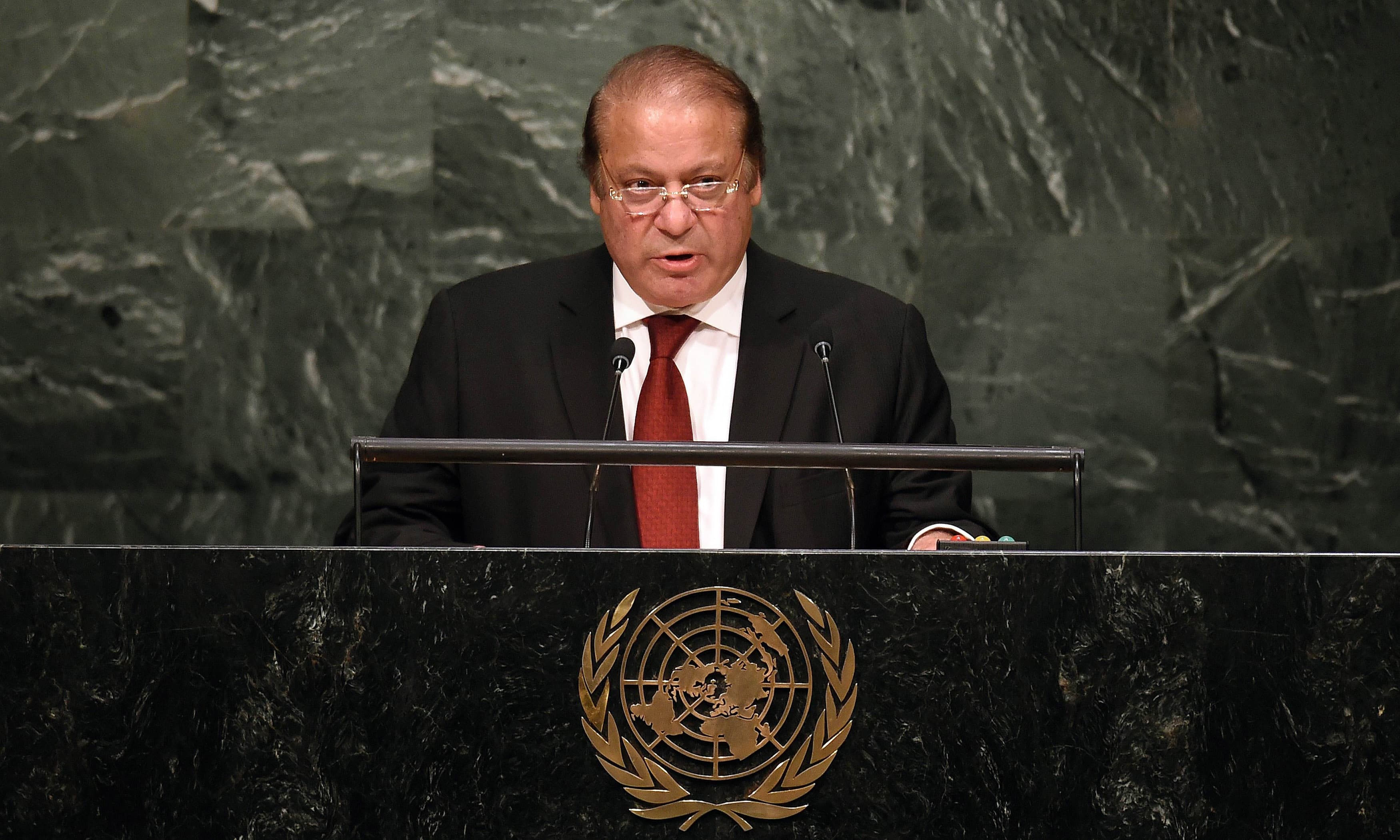



UNITED NATIONS: Prime Minister Nawaz Sharif, while addressing the UN General Assembly's 70th session in New York, proposed a four point agenda to diffuse tension between Pakistan and India.
“Cooperation, not confrontation, should define our relationship with India," said Nawaz.
Yet today ceasefire violations along the Line of Control and the Working Boundary are intensifying, causing civilian deaths including women and children, he added.
“I want to use the opportunity today to propose a new peace initiative with India, starting with measures that are the simplest to implement.”
Nawaz suggested that Pakistan and India should formalise and respect the 2003 understanding for a complete ceasefire on the Line of Control in Kashmir.
For this purpose, he called for UNMOGIP’s expansion to monitor the observance of the ceasefire.
Secondly, the premier urged both the countries to reaffirm their resolve that they will not resort to the use of force under any circumstances. He pointed out that this is a central element of the UN Charter.
Nawaz also proposed that steps should be taken to demilitarise Kashmir.
“Pakistan and India should agree to an unconditional mutual withdrawal from Siachen Glacier — the world’s highest battleground,” he said.
Nawaz said an easing of threat perceptions through such peaceful efforts will make it possible for Pakistan and India to agree on a broad range of measures to address the peril posed by offensive and advanced weapons systems.
“Pakistan neither wants to, nor is it engaged in, an arms race in South Asia,” he asserted.
As a responsible nuclear weapon state, Pakistan will continue to support the objectives of nuclear disarmament and non-proliferation, he added.
Nawaz said South Asia needs strategic stability and this requires serious dialogue to achieve nuclear restraint, conventional balance and conflict resolution.
"Pakistan looks forward to playing its part to build a brighter era of peace and prosperity in South Asia."
Referring to the menace of terrorism, Nawaz emphasised the need to address the underlying causes of the challenge.
He pointed out that Muslims are suffering across the world: Palestinians and Kashmiris oppressed by foreign occupation; persecuted minorities; and the discrimination against Muslim refugees fleeing persecution or war.
Pak-Afghan relations underwent a positive transformation after the advent of the national unity government in Kabul, said Nawaz.
"Pakistan made strenuous efforts to facilitate the process of Afghan reconciliation. Dialogue did open between the Afghan Government and the Taliban, which was an unprecedented first.
"But it was unfortunate that certain developments stalled the process. Thereafter, militant attacks intensified, which we unequivocally condemn," he stressed.
Nawaz said, "Pakistan greatly appreciates China’s proactive role in promoting peace and prosperity in Afghanistan and our region."
"The China-Pakistan Economic Corridor, announced during President Xi Jinping’s visit to Pakistan earlier this year will spur regional economic integration and bring prosperity to the entire region and beyond."