186
186
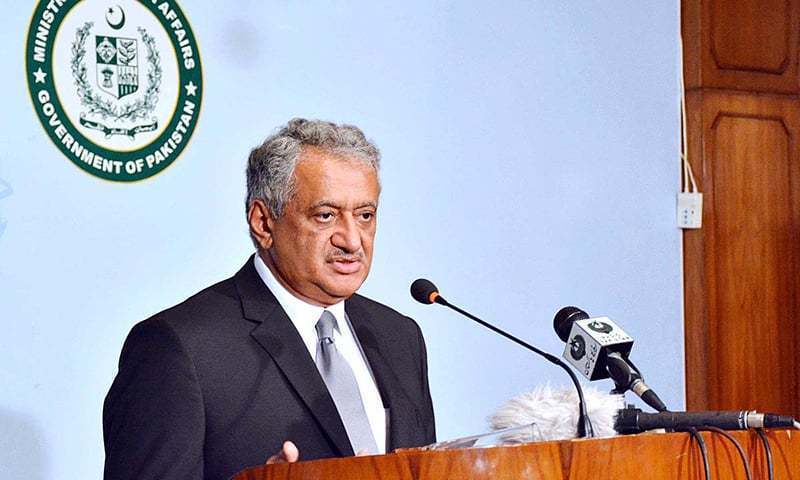
ISLAMABAD: Pakistan on Saturday night said it had come to the conclusion that the proposed National Security Adviser (NSA) level talks between Pakistan and India would not serve any purpose if conducted on the basis of the two conditions laid down by Indian Foreign Minister Sushma Sawaraj.
The announcement comes hours before NSA Sartaj Aziz was to leave for India on August 23.
The Indian foreign minister had earlier today said that India had made clear on August 18 that the scheduled meeting between national security advisers will only discuss issues related to terrorism.
"No other topic will come under discussion," she said, adding that all outstanding issues including Kashmir are part of the composite dialogue between the two countries which had not yet resumed.
Sawaraj had also said India did not recognise a third party in talks with Pakistan, referring to Pakistan's invitation to Hurriyat leaders for a meeting in Delhi.
Take a look: Willing to visit New Delhi without preconditions, says Aziz.
In a statement released in response to Sawaraj's conference, the Foreign Office says:
“While the Indian Minister accepts that, to ensure durable peace between the two countries, there is a need to discuss all outstanding issues through a sustained dialogue process, started in 1998 as Composite Dialogue and renamed as Resumed Dialogue in 2011, she then unilaterally restricts the agenda to only two items: creating an atmosphere free from terrorism and tranquility on the LoC.”
Considering that many terror “incidents” blamed initially by India on Pakistan eventually turned out to be fake, it is not improbable that India can delay the Resumed Dialogue indefinitely by concocting one or two incidents and keeping the LoC hot, said FO spokesperson Qazi Khalilullah in a statement.
Pakistan said terrorism had always been a part of the eight point composite dialogue and was always discussed simultaneously with other issues between the interior secretaries.
"It is not reasonable for India to now assume the right to decide unilaterally that from now onwards, other issues will be discussed after terrorism has been discussed and eliminated."
The spokerson said the main purpose of dialogue between India and Pakistan was to reduce tensions and restore trust as a first step towards normalisation.
"If the only purpose of NSA level talks is to discuss terrorism, then instead of improving the prospects for peace it will only intensify the blame game and further vitiate the atmosphere," he said.
That is why Pakistan had suggested that apart from discussion on terrorism related issues, the two sides should also discuss modalities and if possible a time schedule, for discussions on all outstanding issues including Kashmir, Siachen and Sir Creek, in keeping with the understanding of the Ufa statement.
"The Indian minister's attempt to draw a distinction between preambular and operative paragraphs in the Ufa statement appears to be an after-thought to justify a position that is counterproductive in terms of the ultimate objective of reducing tensions and improving trust."
As regards the second pre-condition regarding meeting with Hurriyat leaders, the FO spokesperson said it had been pointed out repeatedly that the meeting with Kashmiri leaders was a long-standing practice whenever Pakistani leaders visited India during the past twenty years.
It would be inappropriate for India to now impose the condition of changing this longstanding practice, he said.
"Pakistan, therefore, reiterates that the scheduled NSA level talks cannot be held on the basis of the preconditions set by India."
India had virtually called off talks on Friday (yesterday) after Pakistan rejected its advice to not hold talks with Hurriyat leaders in New Delhi. Pakistan had conveyed to India it would not hold talks on any pre-conditions, adding that Hurriyat leaders were a genuine stakeholder in the Kashmir dispute.
Also read: Indo-Pak security adviser level talks in jeopardy.