0
0
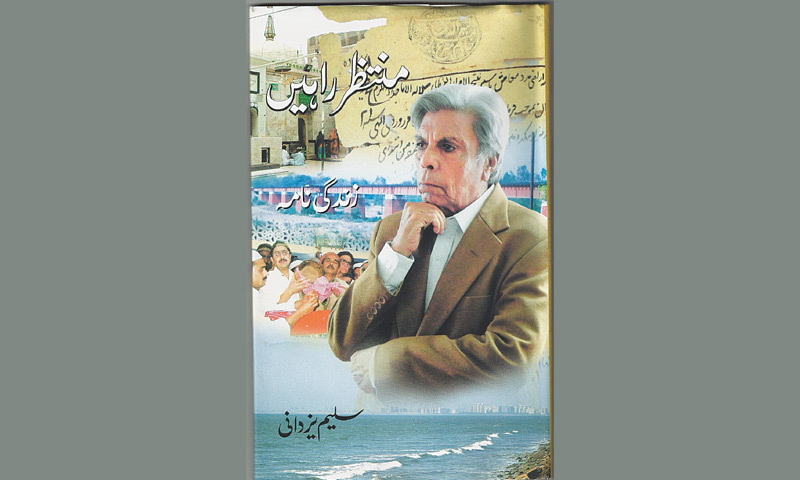
Though he has been associated with journalism for quite long, it is not the only domain in which Muhammad Zafar Fareedi, aka Saleem Yazdani, has expressed his multifaceted talent: he is a broadcaster, short story writer, columnist, political analyst, critic, dramatist, lawyer and homeopath. But what he takes most pride in, as is evident from his new book, is being a Seerat writer.
This new book by him, Muntazir raahen, is aptly subtitled Zindagi nama. It instantly reminds one of Nazeer Akbarabadi’s poems that so wonderfully portray life, its colours and its vicissitudes and epitomise the lessons learnt from living a life to the full.
Nazeer had the mind and spirit of a Sufi. He roamed about in India, extending his love to people he met and collecting pearls of wisdom by studying human nature. Nazeer in his poetry has depicted, in a simple but elegant language, lives of the common people and has spread the message of love and kindness.
Saleem Yazdani, too, in his autobiography sounds like Nazeer: a direct descendent of the great Sufi saint Hazrat Baba Fareed Ganj-i-Shakar, he is a Sufi first and foremost, despising those who matter in worldly affairs and asking God for favours instead of humans.
Saleem Yazdani has written a simple yet flowing prose. He served Radio Pakistan for quite long in different capacities and rubbed shoulders with scores of intellectuals. He talked to renowned personalities, politicians, ministers and heads of states and governments. But just like Nazeer Akbarabadi, he has observed the world and lived a life with the detachment of a Sufi. But he did not forget to collect pearls of wisdom that he found during this journey, some of which he has shared with his readers.
In the book we see a young boy from Sheikhupur — a small town near Badaun in Uttar Pradesh — grow, learn, migrate and become a well-known writer and producer in Pakistan. Saleem Yazdani has narrated his journey from his hometown in the UP to Karachi and we see a life lived to the fullest but with asceticism and spirituality.
Surprisingly, there are no ladyloves in the book, though we expect a poet, writer and Radio producer to be surrounded by sweethearts and to find at least half a dozen love affairs in his autobiography. Yes, there is a ‘leading lady’ in the book that appears quite early in the book, but not in person or reality but in a dream.
Later, the author sees that girl as a teenage beauty, instantly falls in love with her, marries her — and perhaps as an anti-climax — they live, believe me, happily ever after. In fact, the display of sincere love between husband and wife in this book is not the only exemplary but it also becomes a major theme of the book.
Rarely have we come across an autobiography by an intellectual which talks of no romance but marital love. What a contrast, we note, when we compare it to Josh Maleehabadi’s Yaadon ki baraat which boasts of no fewer than 18 affairs. Saleem Yazdani’s love is for all humanity.
Another major theme of the book is spirituality and spiritual experiences, some of which are hard to believe. But as Saleem Yazdani is a no-nonsense type of person, we have to believe that these incidents actually took place. His meeting with some mysterious fakirs and saints, his dreams that came literally true and his spiritual experiences, all are something to reckon with.
But man and wife’s love and religio-spiritual phenomena is not all that this autobiography offers. It is a vivid account of our political history, too.
As the writer had the chance to meet, interview and befriend some politicians, he describes some important events of our political history. Some of the events described in the book depict Zulfikar Ali Bhutto during some candid moments.
For example, when Mr Bhutto talked to Maulana Kausar Niazi, his cabinet minister, who was at the airport to see Mr Bhutto off, the author standing close by heard Mr Bhutto saying to the Maulana: “I know what you are up to and I will see you when I come back”.
Similarly, the gist of a speech has been reproduced in the book that Mr Bhutto made before the ambassadors and foreign diplomats. It was ordered to be deleted from the tapes as some ambassadors had taken exception to it. The author was recording the speech for the Radio Pakistan.
What we must appreciate about the book is that while narrating political events and commenting on certain political personalities, such as Mr Bhutto or Zia-ul-Haq, the author has tried to be impartial. In fact, some portions of the book read like an eyewitness account of an era gone by.
The descriptive account about some literary figures such as Aziz Hamid Madani, Qamar Jameel, Saleem Ahmed and others reads like pen-sketches. It also makes the portions of history of Radio Pakistan and PTV come alive. Some rare photographs have added to the value of the book.
But one feels that what this book needed before going to press was proper editing. An efficient editor would have trimmed it by one-third or so to make it crisper. At times Yazdani is repetitive, extensively quotes from his own previous writings and tries to unduly dramatise the situation. Repeatedly referring to his ancestral religious background, though we have respect for it, may be a little irksome for some readers.
Priced Rs1,800, the 530-page book is a bit too expensive.
Published in Dawn, December 29th, 2014