6
6
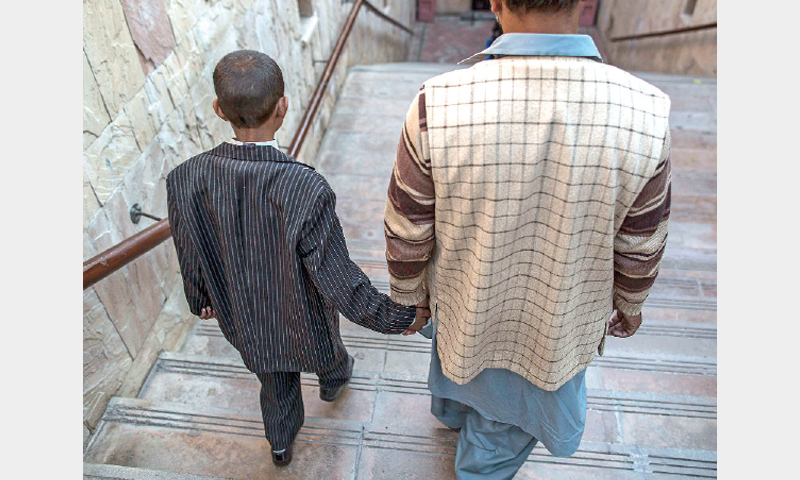
ISLAMABAD: Life has become difficult for 12-year-old Waqas Mehmood, a Human Immunodeficiency Virus (HIV) carrier, as he falls sick whenever he stops taking medicines.
Waqas contracted virus after allegedly undergoing unscreened blood transfusion.
On Friday, he was among the participants of an event organised by the United Nations Development Programme (UNDP) at the International Labour Organisation (ILO) auditorium in connection with the World Aids Day.
Nusrat Mehmood, the father of Waqas, told Dawn that he had four children and Waqas was the only child affected with HIV.
“In 2007, Waqas started falling sick frequently. I took him to different clinics and every time doctors gave him antibiotics. This continued for two years but the issue could not be resolved. On the other hand, the child kept on losing weight.”
Mr Mehmood said in 2009 he took the child to Combined Military Hospital (CMH) Rawalpindi as his weight decreased to seven kilogrammes. “After conducting some tests, doctors at the CMH informed me that Waqas had HIV. They referred me to the Pakistan Institute of Medical Sciences (Pims) where my son has been undergoing treatment since then.” He said after four years’ treatment Waqas had improved and now weighed around 24 kilogrammes.
Father says his son Waqas Mehmood contracted HIV after a blood transfusion nine years ago
In reply to a question, Mr Mehmood said he worked as a sailor in the Navy. In 2005, his son had measles and was admitted to a hospital in Karachi.
On the advice of the doctors in the hospital, blood was transfused to Waqas.
In 2007, Waqas suffered from different diseases and after two years HIV started showing its symptoms.
“By that time, I got retirement from service and shifted to Wah Cantonment.
“I cannot afford filing a court case against the hospital for allegedly transfusing contaminated blood to my son. I am thankful to God that my other three children are healthy,” he said.
Waqas said he frequently fell sick and felt pain in the body if he stopped taking medicines.
Meanwhile, at the event, most of the discussions revolved around the incident in which at least 10 children afflicted with thalassemia were tested positive for HIV after allegedly being transfused contaminated blood.
Pims Vice Chancellor Dr Javed Akram said blood screening should be ensured before transfusion.
“Almost 20 per cent patients suffering from thalassemia are affected with Hepatitis C and one per cent with HIV just because of unscreened blood transfusion. It takes 20 minutes to screen the blood,” he said.
Dr Akram said there were some organisations who were working for thalassemia patients but their objective was to give blood to as many children as possible because by showing the numbers they claim donations at the national and international level.
“Non-governmental organisations and departments should sit together to resolve the issue. Moreover, professional blood donation should be discouraged,” he said.
Project Director Safe Blood Transfusion Programme Dr Hasan Abbas Zaheer, who is also the member of a fact-finding mission to look into the issue of children affected with thalassemia, said a number of blood banks used substandard kits for screening blood.
“Because of the substandard kits, there are more chances that virus would not be detected and contaminated blood would be given to patients,” he said.
Nusrat Jabeen, a health worker, said it was a very difficult job to tell a person that he was affected with HIV.
“Sometimes people react very strongly and even try to commit suicide. They stop having medicines because they believe that now their life is over,” she said.
A study titled ‘HIV and Aids in workplace in Pakistan’ conducted by the ILO was also launched on the occasion. The study recommended that provinces should be supported to develop their own labour policies.
People living with HIV should be accepted at workplaces. Awareness of HIV should be part of the training of trade unions. It was also recommended that a commission should be established to work out on the cases of denial of jobs to people based on their perceived or real HIV status.
Country Director ILO Francesco d’Ovidio said there should be no discrimination against people living with HIV.
Country Director UNAIDS Marc Saba said education and protection was the right of every person.
Programme Manager National Aids Control Programme (NACP) Dr Baseer Khan Achakzai said Rs3 billion had been allocated by the government for HIV/Aids control.
Published in Dawn December 6th , 2014