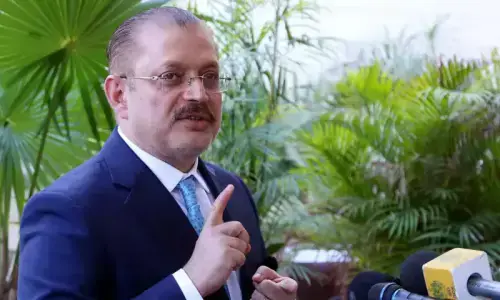
ISLAMABAD: Muttahida Qaumi Movement (MQM) leader Farooq Sattar on Friday called out the Pakistan Tehreek-i-Insaf (PTI) for talking about decentralised governance in other parts of the country, while in Sindh, the party was pursuing a completely different strategy.
Speaking to media representatives outside Parliament, Sattar said Sindh was generating high revenues for the treasury, of which he alleged very little was being given back to the province.
MQM has upped the ante over its decentralisation demand across the country - and Sindh in particular. MQM Chief Altaf Hussain recently stated that more administrative units and provinces should be created for strengthening the country.
This demand comes at a time when PTI Chairman Imran Khan is scheduled to address party workers in Karachi on September 21. PTI, which is currently holding sit-in protests in Islamabad for over a month, has a strong presence in Karachi where workers have been regularly organising rallies since the beginning of the Azadi march on August 14. This is why the city was selected as Imran’s first stop in what PTI has called the party’s attempts to spread its movement to other parts of the country.
In his address to a crowd in Islamabad late on Thursday, the PTI chairman said he was coming to free Karachi from the shackles "of a mafia" and "the fear enveloping the people of Karachi".
Also read: Altaf reiterates call for more provinces
Referring to the PTI’s upcoming rally in Karachi, Sattar said: “Sure, take out a rally in Karachi if you want, but how will you face the people of Karachi and Hyderabad if you will not show sensitivity to the violation of their rights?”
The MNA added that those who were raising their voice regarding the strengthening of democracy and Parliament should also discuss how over-centralisation of power had become problematic for Pakistan and was a hindrance to the country's development.
“We need to have governance in accordance with the requirements of an area; we need to think about where the formation of more provinces is necessary and where the creation of more administrative units is important,” Sattar said.