0
0
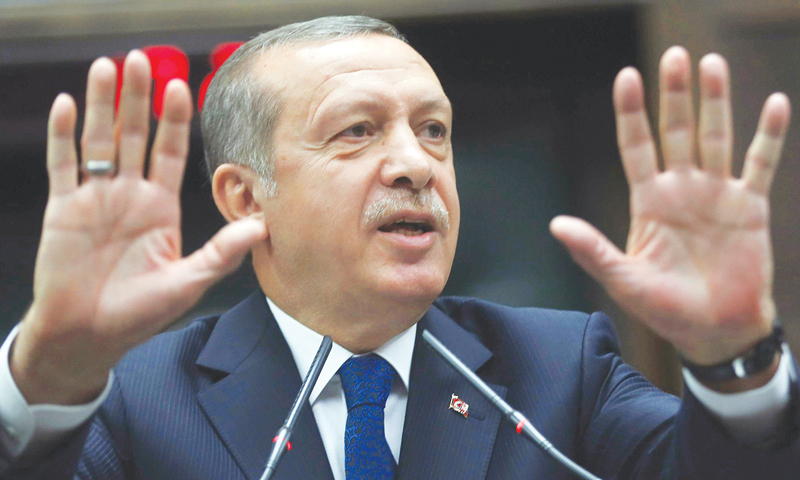

ANKARA: Turkey’s Prime Minister Recep Tayyip Erdogan is set to announce his candidature for presidential elections in August despite deepening concern over his polarising rule.
Already in his third term as prime minister — the maximum permitted under his Justice and Development Party (AKP)’s rules — Erdogan has made no secret of his ambition to run for president.
The party is not expected to name its candidate for two more weeks, but little mystery remains over the choice.
“You know who it is. Don’t make me say it,” deputy prime minister Bulent Arinc told journalists on Sunday.
But the August election — the first time Turks will directly elect their head of state — comes at a fraught time for Erdogan and Turkish society.
The past year has seen anti-government protests on an unprecedented scale, a huge corruption scandal and an angry response to a mining disaster.
Erdogan can still rely on massive support from pious supporters particularly in rural areas, but he has lost considerable ground among a vocal secular middle-class who fear the country is sliding towards autocracy.
But while a few other names have circulated for the presidency — including deputy prime ministers Ali Babacan and Besir Atalay, and intelligence chief Hakan Fidan — all are Erdogan loyalists.
None are expected to present a serious challenge to their boss, who remains hugely popular after an 11-year rule in which he has tamed the military, returned Islam to public life and overseen rapid economic growth.
New kind of president
Erdogan’s temperament is likely to ensure that the presidential post becomes far more than a ceremonial role.
“It will not be a president of protocol, but one that sweats, runs around, works hard,” Erdogan said in April.
“While Erdogan cannot formally change the current set-up into an executive presidency, the Western expectation is that he will bring to the presidential palace his own style of government, made up of a populist narrative at home and a defiant attitude with partners abroad,” wrote Marc Pierini, a Carnegie Europe analyst, earlier this month.
While the current president, Abdullah Gul, tried to be a unifying force, Erdogan’s refusal to placate his critics could have the opposite effect.
Since unprecedented protests shook his regime a year ago, Erdogan has suppressed any sign of dissent, often riding rough-shod over democratic safeguards and attracting criticism at home and abroad.
Turkey’s middle class has been further alienated by controversial rulings, including curbs on the internet and the judiciary, as well as restrictions on alcohol sales.
Engulfed by a massive corruption scandal in December, he responded by painting himself as the victim of a widespread conspiracy plot by his erstwhile ally Fethullah Gulen, an exiled cleric with widespread influence in Turkey’s security forces and bureaucracy.
As with the protesters of June 2013, Erdogan liberally threw labels such as “terrorists” and “traitors” at them.
His polarising tendencies have done little to damage his overall popularity, ensuring another landslide victory for his party at local elections in March.
“Erdogan has invested hugely in his ‘friend-or-foe’ strategy since the beginning of last year’s mass protests. He wanted to show his supporters that he is a strong leader protecting the country against all enemies,” said Fethi Acikel, a political scientist at the University of Ankara.
“I don’t see him giving up this strategy which has proved so successful at the ballot box, but has severely dented Turkey’s image at home and abroad,” he said.
In scenes that have become familiar over the past year, police last week cracked down severely on demonstrators in Istanbul and Ankara. Thousands had gathered to mark the first anniversary of environmental protests in Gezi Park, which spiralled into broader rallies against Erdogan’s rule across the country.
According to the Progressive Lawyers Association, at least 126 people were taken into custody in Istanbul alone.
“The way in which the government treats us is becoming more and more violent,” said a protest spokesman, Tayfun Karaman. “They no longer know what to do to stop people getting involved in politics in their own country.” Many hope Erdogan will use the presidency to ease the political tensions and reach out across the political divide.
“The prime minister wants to be elected president but he simply cannot accept that people hold peaceful rallies for the victims of citizen protests,” wrote columnist Mehmet Yilmaz in Hurriyet.
“He wants everyone to shut up and listen to him.”—AFP
Published in Dawn, June 4th, 2014