14
14


WASHINGTON: An expert panel on Wednesday urged the United States to add Pakistan to a blacklist of violators of religious freedom, saying that the Ahmadi minority suffers “apartheid-like” conditions.
The US Commission on International Religious Freedom, which advises the government on policy but does not take action on its own, urged the State Department to add Pakistan to its list of “countries of particular concern”subject to potential sanctions.
In an annual report, the commission said Pakistan “represents the worst situation in the world for religious freedom” among countries that are not already on the US blacklist and that conditions in the past year “hit an all-time low.”
Robert George, chairman of the commission, voiced alarm over treatment of the Ahmadis, who were declared by Pakistan to be non-Muslims in 1974.
“The Ahmadi minority in Pakistan live under something really resembling an apartheid-like system subject to severe legal restrictions,” said George, comparing the situation to South Africa's 1948-1994 system of forced racial separation.
“They suffer from officially sanctioned discrimination, not just social or cultural prejudice,” he told reporters.
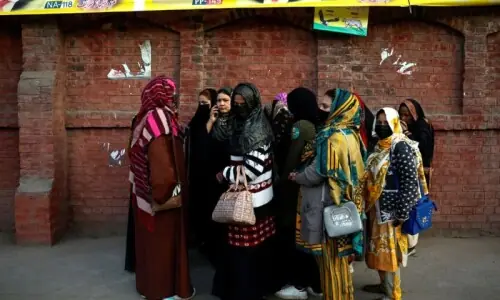
Ahmadis have faced a series of deadly attacks and desecration of their graves. Ahmadis boycotted last year's election because they would have had to identify themselves as non-Muslims.
The report also voiced alarm about Pakistan's treatment of Hindus, Christians and Shia Muslims. It said Pakistan has sentenced to death or jailed for life 36 people for blasphemy, far more than any other country.
The United States has urged Pakistan to improve its treatment of religious minorities but has stopped short of putting the country, an uneasy ally in the Afghanistan war, on the blacklist.
The United States designates eight nations as countries of particular concern: China, Eritrea, Iran, Myanmar, North Korea, Saudi Arabia, Sudan and Uzbekistan. The commission urged the State Department redesignate all of them.
Besides Pakistan, the commission once again called on the State Department to add to the list Egypt, Iraq, Nigeria, Tajikistan, Turkmenistan and Vietnam.
And, in an addition from the previous year, the commission called on the State Department to put Syria on the list, saying both President Bashar al-Assad and his largely Sunni rebel opponents are responsible for “egregious”violations.
The United States has imposed export restrictions and other measures against countries of particular concern although successive administrations have waived sanctions against ally Saudi Arabia.