0
0

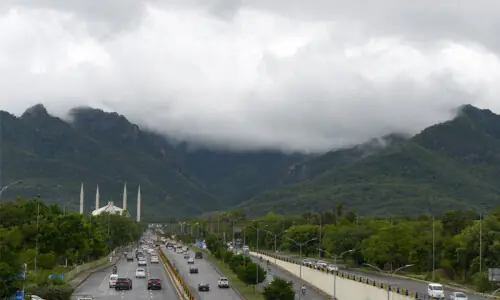
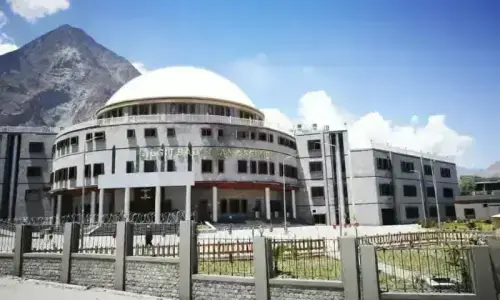
National Library of Pakistan, situated at the back of Prime Minister's Secretariat and Supreme Court building at the Constitution Avenue, was known only to its members, active literary circles, theater enthusiasts, and local journalists till December last year.
When the special court constituted to conduct the trial of former Chief of the Army Staff Retired Gen Pervez Musharraf for holding the Constitution in abeyance, held its first hearing in December last year, the building of the library came to the limelight.
Spread at 168,844 square feet, the four-storey building of the national library that has four vast reading halls, possesses around 300,000 books including over 10,000 rare books in Urdu, Arabic and Persian, hundreds of journals and newspapers and several assets of Brails, visual and digital knowledge for the members.
About 3,000 microfiches items containing reports of All India Censuses for 1911, 1921, 1931 and 1941 are also part of the collection.
The library has a capacity to accommodate two million volumes and 500 readers at a time.
Its auditorium has a capacity of 400 people. It has been considered a venue for book launches, literary events, memorial conferences, theatres, award ceremonies and occasionally for music and dance shows (mainly the classical) till December last year.
But now it is a centre stage for the most interesting case of power puzzle as the special court is conducting here the trial of a military dictator, for first time in the country’s history.
The dictator, who has now surrendered himself to the court, appeared at the Library auditorium on February 18 but the venue had already been highlighted in the local and international media.
The building of National Library of Pakistan (NLP) was completed in 1993 and is a legal depository for all published literary heritage of Pakistan.
“It serves as top most knowledge resource center of the nation as well as fountain head of Library developments in the country,” Chaudhry Mohammad Nazir, Director General of National Library of Pakistan (NLP), said while highlighting importance of the institution.
But the federal ministry for law found it the most appropriate place to hold the trial of the former military ruler Retired General Pervez Musharraf, who is first among all four dictators to be held accountable for his unconstitutional steps.
His three predecessors, Gen Ayub Khan, Yahya Khan and Zia-ul Haq died untouched.
Musharraf’s lawyer and the most vocal spokesman Ahmed Raza Kasuri, however, still did not believe it can be a suitable place to hold the trial of a person of ‘Musharraf’s stature’.
“It’s more like a theatre for Shakespeare’s drama than a court,” he said while criticising the arrangements made to organise the court in the library auditorium on the first day of the hearing.
But the authorities say they chose this venue because it was the safest place to conduct such a high profile case.
“We considered various other buildings but none of them was as safe and suitable as this auditorium of the national library,” Zahidullah, a spokesman for the ministry of law and justice, told Dawn.
The auditorium has around five feet high stage, wood crafted walls, over a dozen glass windows of the size of the full wall, and beautiful Ajrak style roof ceiling.
Interestingly, a huge and modern heating system, installed at the building, never worked inside the auditorium during the hearing of Musharraf case in the cold times of December and January.
Officials say that ‘the heating system has become ineffective because of the low gas supply’.
Since the auditorium of the national library has been converted in to a court, over 1,100 members and 180 employees of the library are facing hardships.
“Policemen don’t allow our cars inside the premises of our building while all lawyers bring cars inside parking. We have to walk through a long way and get permission from security officials to enter into our own building,” said a library official on the condition of anonymity because he is not authorised to talk to media.
The readers say that the conversion of the library auditorium into a court has wasted much of their precious time.
“We were a group of up to 150 students who were consulting library books for the competitive examinations. But the security officials deployed here to protect the court, don’t allow us during the proceedings now,” said Aftabullah, a candidate preparing to appear in the Central Superior Services (CSS) examinations.
“Now hardly six people come over here because of security checks,” he said.
“This court has spoilt my preparations for examinations. It has cost us 7 hours of studies daily from last two months,” he said.
The officials said they charge Rs30,000 as rent per day to anybody who books the auditorium for an event.
Many scheduled events at the auditorium had to be cancelled because of the court proceedings and it resulted in huge financial losses to the management.
“We have to give revenue of around Rs1.2 million to national exchequer from the auditorium income. We have written to the ministry of law and justice to pay us rent for special court proceedings but they did not reply to our letter,” the library official said.
The security officials said the building was not totally safe and they could arrange same security anywhere.
“The safety is not in the building but the people who are guarding it. We could provide same security at any building for this court,” a senior security official, responsible for court protection, told Dawn.
“If you ask me that this building itself is secured enough for this court or not, then I will say that the Supreme Court building is far safer then this to conduct such a high-profile hearing,” he said.
Chaudhary Mohammad Nazir, however, said they have no objection to the government decision of holding a court in the library auditorium.
“We have to obey government instructions. If they ask us to vacate the whole building for this court, we have no option but to vacate it,” he said.