0
0

State your position
THE quest for a consensus on the war on terror must continue, though it remains to be seen whether the in-camera briefing by the military to the MPs leads in that direction. Whatever little bit has come out of the closed-door briefing and the senators’ and MNAs’ response to it is not encouraging. The government insists that it is following a three-pronged strategy that combines a selective use of force with offers of talks and the tribal belt’s economic development. The Musharraf government too had been saying this, with little or no sign yet that the back of the insurgency has been broken. In fact the insurgency has spread from Waziristan to all of Fata and even to Swat, and this clearly proves that the three-pronged strategy is not working. The PPP-led government must, therefore, re-examine the flaws in the current approach and come up with a new result-oriented policy so as to prove the opposition wrong when it claims that Mr Zardari and company are merely following the military-led regime’s policies. Clearly, the government is vulnerable here.
Let us recognise one major factor that should serve to strengthen the Taliban’s confidence. America, Britain and Saudi Arabia now seem to be having second thoughts about the war and appear willing to adopt a less jingoistic attitude. Some European leaders too have started thinking on these lines. Against this backdrop, MPs on both sides of the aisle have to rise above partisan considerations and ‘own’ the war on terror. If you do not agree with the government’s policy, you must come out openly with precisely what you have in mind. Some of the government’s harshest critics — Qazi Hussain Ahmed and Imran Khan, for instance — have opted out of the democratic process and are at liberty to talk ad nauseam. But those who are part of the parliamentary opposition have to move away from rhetoric and refrain from playing to the gallery. If they think the government’s policies have entered a cul-de-sac or are in fact counterproductive, it is their moral responsibility not to confine their stance to criticism but to state their position clearly and commit themselves to a course of action they think is in the nation’s best interest.
The tribesmen are now in the picture. This is a major asset for all those who believe that the Taliban are a minority and that they can be cornered and defanged if the vast majority of the people in Fata are made allies in the war on terror. By organising their lashkars the tribal elders have shown that they consider the war on terror as their own, for no one has suffered more from the ravages of war than Fata’s innocent men, women and children.
A grim future
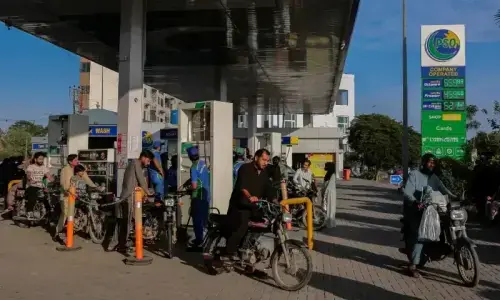
AS we grapple with the rising cost of food and fuel on a day-to-day basis, a World Bank report released on Sunday has pointed to the consequences of such inflation over the long term. The Bank has etched a gloomy global picture where high domestic prices indicate “a threat to basic survival”. Millions who are already living in miserable, poverty-stricken conditions stand to be worst affected with essentials like proper nutrition and education eluding them altogether. Consider the figures for nutrition. According to the report, while the number of malnourished people was 848 million in 2003 — and has been rising since — the current state of prices could push this figure to 967 million within this year. Countries like Pakistan, where poverty alleviation programmes have done little to improve the lot of the poor, will particularly feel the brunt of high domestic prices because they lack social safety nets that could help cushion the impact. Already Pakistan has abysmal statistics for education and falls in the category of nations with a large number of malnourished people. Add to this a high population growth rate and we have a recipe for disaster in the years to come if present economic trends continue.
However, diminishing access to education and poor nutrition are only two aspects of the consequences of inflation. There has been an alarming rise in the number of suicides in the country, figures for crime and aberrant incidents where couples have offered to sell their children to combat destitution. There has been a marked increase in social frustrations which affect family life and threaten to undermine age-old values like caring for old parents at home. As people are forced to live with stagnant incomes in an era of ever-rising prices, their frustrations can only grow and tell upon the family unit in a variety of negative ways. The picture for the future is not only sombre; it is downright frightening as one envisions a large body of unemployed, uneducated youth with nothing to look forward to in life. For many young suicide bombers, it is not merely religious indoctrination that motivates them; it is also the assurance that their families would be looked after financially once they have succeeded in their mission. The odds may be stacked against us in the current financial crisis. But there is no reason why our policymakers can’t attempt to lift the poor out of their predicament, even if it means depriving the well-heeled of some of their privileges.
India and water
PRESIDENT Asif Zardari swam against the current when he recently said India was never a threat to Pakistan. His latest take on the next-door neighbour is more reflective of the uneasy natural bonding that the two countries cannot come out of. The president says an Indian blocking of Chenab water could jeopardise a relationship he appears keen to mend and promote. Others in Pakistan may share his sentiment about peace and the role that divisive water issues can play in holding Pakistan and India hostage to a hostile past. There is however no dearth of experts here who hold that no mechanism exists to check the construction of a reservoir by India on a river formally assigned to Pakistan under the five-decade-old Indus Water Basin Treaty. Baglihar Dam, inaugurated in Indian-controlled Kashmir last week, is a prime example. Indeed, while the controversial project was under way Pakistani experts were labelling the Indus treaty as an unsatisfactory document favouring India.
This may be true but equally significant is the fact that the treaty has served as a useful agreement between easily excitable parties. Pakistan’s domestic experience with the issue would suggest that it is not that simple to distribute water among desperate claimants. The inter-provincial accord took a long time coming, and when it was finally signed in 1991 it was far from being the last word on the subject. The fall in water supply and its quality further widens the gulf between provinces, especially between Punjab and Sindh. According to studies, the per capita water availability in the country is down from 5,000 cubic metres per person in 1947 to 1,200 cubic metres. The traditional sources — the Indus system and underground water — are running dry, and while the country must look for alternatives it has to guard against unkind cuts in supply. The end where one neighbour does not represent a threat to the other can only be achieved through talks. There is no reason why Islamabad cannot propose modifications for reasons of clarity, and no reason why a New Delhi that sees other past resolutions as obsolete shouldn’t respond positively.
Saying what the US wants to hear
NO passport has yet been devised that can take one easily across the borderline of fear. Pakistan used to fear annihilation by India; now it fears hegemony. India used to fear invasion across the Line of Control in Kashmir; now it fears the export of terror.
One nation’s freedom fighter can, of course, be a neighbour’s terrorist. Pakistan may sincerely want peace with India but it still has not reconciled itself to peace in Kashmir. Politicians, bureaucrats and generals sitting across a walnut table are not the only ones who determine the management of visceral fear. The street also has a say, the Pakistani street being a less than melodious orchestra of mohalla, madressah and media.
Might I offer a suggestion for the new kid on the block, Asif Zardari, once ‘Mr Ten Per Cent’ and now the honourable President of Pakistan. The next time he feels inclined towards discussing Kashmir in an interview, he should outsource the interview to his spokesman. It will save him the bother of claiming he has been misquoted or misunderstood.
Is there any rational explanation for what Zardari definitely told The Wall Street Journal — that those who had picked up the gun and bomb in Kashmir were terrorists, and that India has never been a threat to Pakistan?
Part of the reason lies in the fact that he was speaking to a conservative American paper. Zardari obviously shares one trait with India’s prime minister, who in September offered the true love of every Indian to George Bush, the most hated president since polls began to measure such sentiments. Zardari was telling a Republican paper what he thought the White House wanted to hear. But this is useful only if it meshes into a larger framework.
Washington is reorienting its policy towards the entire region between Kabul and Delhi, and the basic foundations are being repositioned for a new architecture. At the centre of this shift is recognition that the failing war against Afghanistan was deeply flawed by an error of judgment. It should have been against Al Qaeda, fountainhead of terrorism, and not against Taliban, government of the Afghan nation.
The determined Taliban have not only turned the flow of battle but have emerged as champions of Afghan nationalism and good governance, compared to the utter corruption and incompetence of the Hamid Karzai regime. The British commander in Afghanistan admitted in the first week of October that absolute military victory was impossible and that if the Taliban were prepared to sit across the table this ‘insurgency’ could be concluded.
He was only making public a process that had already begun. Between Sept 24 and 27, King Abdullah hosted a dialogue between 11 Taliban delegates, two Afghan officials, a representative of Gulbadin Hekmetyar and three others. The talks had the official backing of the British government, and the unofficial support of the United States. America and Britain are talking to those they went to war against after 9/11 in the belief that they were ‘terrorists’. Their rhetoric still describes the Taliban thus.
It is clear that the US and UK are trying to declare victory before they get out of a war they cannot win. But since America cannot be defeated by ‘terrorists’, the Taliban will have to be redefined.The Taliban are delighted to play ball. Mullah Mohammad Omar has conveyed, through his representatives at the Saudi talks, that the Taliban were no longer allied with Al Qaeda.
Pakistan has repeatedly been told by Washington to disassociate itself from terrorists, a tactic that has become second nature to the ISI. If the Taliban can walk away from Osama bin Laden, then Pakistan should be prepared to abandon Kashmiri terrorists.
In an ideal Anglo-American scenario, the security gap left behind by departing Nato forces would be filled by an informal, if difficult, alliance between India and Pakistan. This cannot happen as long as Kashmir remains a source of conflict. Hence, a new arrangement for the region needs a resolution of Kashmir. This process cannot begin unless Islamabad decides that Kashmiri militants are not freedom fighters. Once this happens, the status of Kashmir can be negotiated.
In an interesting twist of fate, Pakistan has now more to fear from terrorists on its West than from India. It is only such a context that makes some sense of Zardari’s assertion that the real threat to Pakistan is not from India. He is right, of course: India has never had any desire for any Pakistan territory, preferring to let Pakistan stew in the contradictions of its own politico-ideological concoction.
For Zardari, this would mean burial of the strategic legacy of another man he should hate with passion, Gen Ziaul Haq, who led the coup against his father-in-law Zulfikar Ali Bhutto and later hanged him. Zia convinced his country that what had been impossible through conventional war could be achieved through unconventional means. It was an attractive proposition in the 1980s: Punjab seemed utterly vulnerable and it was obvious that India could not hold on to Kashmir if it lost Punjab.
Zia, a packed package of craft, wooed India’s opinion-maker elite with time, double-talk, carpets and silver teapots in the hope they would find rational arguments for abandoning the defence of Indian unity. Two decades later, elitist knees continue to wobble far too quickly in Delhi.
Zardari’s first serious attempt to test the elasticity of Pakistan’s thinking has rebounded: the elastic has snapped back sharply enough to loosen a molar or two. He could not recognise the power of the Pakistani street because he has never worked on it. He has usurped the authority of the prime minister and turned the office of the president into the centre of power. It was a constitutional coup, aided by a sycophantic political party and a fragile polity. But bullying will not alter a Pakistani’s most durable article of faith that Kashmir belongs to Pakistan.
One presumes Zardari has learnt a primary lesson: sometimes it is easier to get into office than to sit in it.
The American argument can be beguiling to Islamabad, that when a final prospect of peace is offered, the Indian elite will accept the compromises in geography necessary to make a Kashmir deal palatable to Pakistan. A trial run has already been established in the nuclear pact, where vital commitments have been sacrificed by Delhi and ignored by most of the Indian elite, whether in parliament or the press. Mediocre leaders have an almost incurable urge to ‘enter history’ through a single triumph, even if this means tweaking the national interest here or there. Zardari seems to have bought into the American dream for South Asia.But nations are not chess pieces which can be arbitrarily rearranged through clever moves. Rulers might dream of turning a pawn into a queen; in real life, kings end up as pawns much more easily.
Obsession with the US
THE UK is mesmerised by the American presidential election. The result will affect all our futures. But is it too much already? Vast resources go into the coverage, leading to a fabricated, even forced, identification with the hyper-power; a euphoric mood is daily whipped up by fervently Atlanticist pundits.
Question the United States and you are slammed for “anti-Americanism”. There are no equivalent sneers for those who, for example, criticise Russia or India. It is as if this country is an extension of the US. It is defiantly, patently not. In fact, the more this drama unfolds, the more intensely aware we become of how different we are. The ocean between us is physical and cultural.
Two observations ensue. It will be decades before Britain elevates a man of African ancestry to the position that Barack Obama has reached. On this, the US has shown us a face that is wholly to be admired, impossible to reproduce on these isles, as yet. On the other hand, we Britons would never cheer on, to teetering heights, a Sarah Palin. One reason is ingrained sexism — why the deputy leader of the Labour Party, Harriet Harman, is never given the respect she deserves.
There is much to envy and admire in Jeffersonian democracy: its localism, liveliness, the way it engages citizens, the unpredictable and serious primaries. Britain does not manage as well the crucial balance between the majority will and minority entitlements. No decent democracy surrenders wholly to the first.
Our system, by contrast, feels exhausted at times, stitched up by the powerful, and the result is growing dejection. It may prove lethal one day, this disenchantment.
Reluctant Europeans we may be, but we have made common cause with EU nations on many key issues — abortion, gay rights, human rights, the place of religion in politics, international relations, climate change, and creationism. We do not have the violent, sometimes murderous, clashes of values dividing Americans. Millions of Britons no longer want this special relationship. They believe the obsession with the US is excessive. I think they have a point.
— © The Independent
OTHER VOICES - Sindhi Press
Spectre of Zia
Ibrat
The Afghan issue, the Cold War, Americans’ jihad against the USSR (if this term is still appropriate) and Ziaul Haq continue to haunt us. We are unable to shed the legacy of the general. Zia was different from his predecessors, Ayub Khan and Yahya Khan who were secular.
A recent statement by Rehman Malik has indeed refreshed our memory. He said that to defeat the USSR in Afghanistan, militants from throughout the world were called to Pakistan. The truth is, our country was used for American interests and Zia became instrumental in changing Pakistan into a theocratic state.
Zia cultivated jihadis and built a network of madressahs. During her first tenure as prime minister, the late Benazir Bhutto brought about some reforms in madressahs but her government was toppled swiftly.
Gen Zia introduced extremism, narcotics and the Kalashnikov culture in the country which rocked the very basis of Pakistani society.…. During the Afghan war, militants from all over the world were called to settle in our tribal areas. …. The Afghan conflict and the ghost of Zia are still with us, and, although the dictator died years ago, we are still shackled by his legacy. — (Oct 12)
— Selected and translated by Sohail Sangi